

[Winery Visit] A steep slope where both people and grapes grow. Visiting Coco Farm & Winery.

To select domestic wines for SiKiTO CAFE, which opened in September 2024, I visited Coco Farm Winery in Ashikaga City, Tochigi Prefecture.
This report details their meticulous, handcrafted winemaking process.
Grapes and people thriving on ski-jump-like steep slopes

Coco Farm Winery, located in Ashikaga City, Tochigi Prefecture, is a highly acclaimed winery known for its Japanese wines made from 100% domestic grapes.
It's a popular winery whose standard products have been featured in JAL First Class and at national events like the Kyushu-Okinawa Summit. What also sets it apart is its origin as Kokoromi Gakuen, a facility for people with disabilities.
Upon my visit, the first thing that astonished me was the slope of the vineyard. The average gradient is 38 degrees, and the upper parts are as steep as 42 degrees!

Facing southwest, it receives excellent sunlight and has superb drainage, making it an ideal environment for grape cultivation.

Due to the steep incline, cultivators and tractors cannot be used, so all work must be done by hand. Students from Kokoromi Gakuen, who have intellectual disabilities, are involved in many tasks such as weeding, pest control, removing diseased leaves and fruits, and covering grapes with umbrellas.
Coco Farm Winery

It began in the 1950s when junior high school students from a special needs school in Ashikaga City, Tochigi Prefecture, along with their teacher, cultivated a vineyard on a steep mountainside.
They use no chemical fertilizers or herbicides, and in their winery, winemaking primarily revolves around natural fermentation with wild yeasts.
Kitano Nobo takes 66 months. "Méthode Champenoise" for growing wine over a long period

Coco Farm Winery's sparkling wines, including "Kitano Nobo," are produced using the "Méthode Champenoise" (traditional method), just like Champagne.
Méthode Champenoise is a method where secondary fermentation occurs in the bottle, by adding white wine, yeast, and sucrose. The yeast consumes the sugar and breaks it down, producing carbon dioxide gas and alcohol.
The wine is aged in the bottle for a long time, but the issue is the "lees" (sediment). These lees are grape components and yeast produced during the yeast's decomposition process, and they are undesirable in terms of appearance and mouthfeel.

We received a very detailed explanation of the process for removing these lees.
First, a special riddling rack called a "pupitre" is used. Bottles of wine that have completed secondary fermentation are inserted into the holes of the pupitre.

Very fine lees also adhere to the inside of the bottle and do not collect at the neck by simply inverting it. The bottles are gently rotated and shaken while in the pupitre at a slight angle, gradually collecting the lees at the bottle neck.
This process, surprisingly, takes 8 to 12 weeks, and the daily rotation and shaking of the bottles is called "remuage."
Evidence of Handwork at the Bottle's Base

The lines drawn on the bottom of the bottle change angle by 45° each time, indicating the progress of the riddling. This is a testament to the manual work involved.
While many modern wineries automate this process, at Coco Farm Winery, students from the facility perform this task by hand, one bottle at a time.
Once the lees are finally gathered at the bottle neck, they are removed through a process called "degorgement."
First, the bottle neck is submerged in a "neck freezer" at -30°C to freeze and solidify the lees along with a small amount of wine.

When opened with a special bottle opener, the accumulated lees are ejected by the force of the gas produced during secondary fermentation inside the bottle.

Finally, the wine lost during disgorgement is replenished.

After corking and sealing with a "muselet" (a wire cage and cap), it's finally complete!

Drawn by its delicious taste, I visited to learn about the production process, and learning about Coco Farm Winery's origins and the immense effort put in by its workers further captivated me.
I highly encourage everyone to try it.

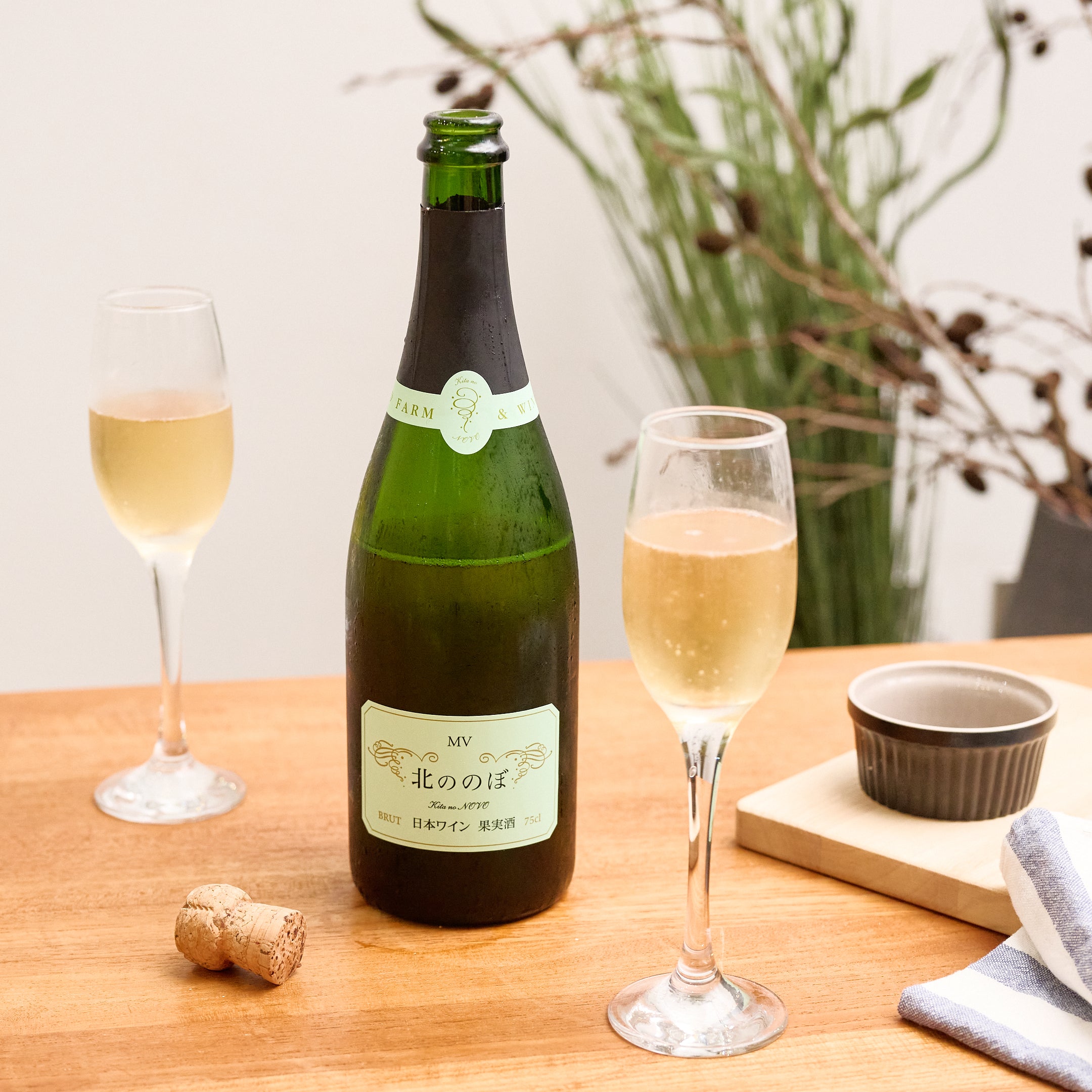
MV Kitano Nobo | Sparkling Wine Crafted with Handwork and 3-10 Years of Aging
See product 〉
View all Coco Farm Winery wines
View product list 〉
PRODUCTS
![[Made to order] Green Summer Wreath made with summer branches (fresh flowers)](http://sikito.com/cdn/shop/files/20250702_-15.jpg?v=1751530871&width=900)
![[Made to Order] Four Seasons and Bonsai: Summer | Japanese Maple](http://sikito.com/cdn/shop/files/yomimono20250912.jpg?v=1756106914&width=900)
![[Pre-Order] Seasons and Bonsai: Summer | Gardenia](http://sikito.com/cdn/shop/files/DSC09951a.jpg?v=1779693971&width=900)
![[Made to Order] Seasons and Bonsai: Summer | Crape Myrtle](http://sikito.com/cdn/shop/files/DSC0468_2.jpg?v=1779774773&width=900)
We also recommend this article


[Branch & Foliage Guide | Autumn] Oriental bittersweet
A deciduous woody vine belonging to ...


