

Giraffe researchers were surprised by the fidelity of the reticulated giraffe 《flerco note》

One day, shortly after the release of flercle note, a post about the realistic depiction of the reticulated giraffe became a hot topic on social media.
We asked Dr. Gunji, a giraffe researcher who posted "The realism is quite high!", for an interview to hear about the situation and issues surrounding giraffes.
You've loved giraffes since you were a child. Do you remember what sparked that love?
I don't remember at all (laughs). Looking at photos from when I was about 1 to 3 years old, I was holding giraffe stuffed animals and drawing giraffes, so it seems they were already special to me back then.
I'm fascinated by their high level of identity, where you can recognize them as a giraffe just by seeing their silhouette or a part of their pattern.

Photo by Megu Gunji
Please tell us what led you to choose a career involving giraffes, specifically anatomy, which you love.
When I thought about my future career during university, I couldn't quite imagine myself working at a typical company.
I decided that if I was going to work for decades to come, I wanted to do something I enjoyed, and that's what sparked my desire to work with giraffes, which I've loved since I was a child.
From there, I consulted various people, including professors who research wild animals. Among them, meeting an anatomy professor who accepted the bodies of deceased animals from zoos for research had a profound impact on me. He told me, "I'll call you if an opportunity to dissect a giraffe comes up," but I thought it was just a polite remark at the time.
However, a few months later, he really did invite me to dissect a giraffe, and that's how I got to where I am today.

Photo by Megu Gunji
Was your first dissection not frightening?
It's similar to flercle note, but "touching" is an incredibly rare experience. It was my first time touching a giraffe then, so rather than being scared, I was deeply moved. It's generally forbidden to touch wild animals, so even though it was deceased, being able to feel its texture, the contours of its "weight" and "size" that had only been images in my mind became clear at that moment.
Real giraffes have slightly longer and stiffer, rougher hair compared to flercle note. However, I felt that the roughness was highly reproduced. I imagine this is the direction you'd take when processing paper to create a giraffe-like feel.

Does the giraffe's pattern remain even if its fur is shaved?
That pattern isn't on the skin itself. However, blood vessels run around the outline of the pattern, so sometimes faintly visible blood vessels can look like a pattern. In fact, each individual's pattern is different, and some researchers use these patterns to identify wild giraffes, record their growth, and estimate their age.
What is the lifespan of a giraffe?
In captivity, it's about 20-25 years, and living to 30 is considered a very long life. In the wild, most live for 15-20 years.
The giraffe's most distinctive feature is its long neck, but why did it become so long?
A giraffe's neck averages 1.5 to 2 meters, and with males standing at 5 meters and females at 4 meters, roughly half of their body is their neck. There are various theories as to why it became so long, with the most prevalent theory currently being that being able to eat leaves from high places was advantageous for survival.
Additionally, it is said that a longer neck is advantageous for "necking" (a fighting behavior where males clash their necks to compete for females or determine dominance), and the theory that stronger, long-necked individuals survived is also strong.
While the neck is an identifier of giraffes, the number of bones is actually the same as humans, at seven. However, one giraffe bone is 25-30 cm, while a human bone is about 2 cm, a difference of 12-15 times.

Photo by Megu Gunji
Dr. Gunji's research revealed that an eighth bone helps extend the neck's range of motion. Are there any other evolved or developed parts?
Animals with long necks like giraffes or large heads like elephants are known to develop a tissue called a "ligament" in the nape of their neck, very similar to a human Achilles tendon. A giraffe's neck and head can weigh 150-200 kg, and they support this not only with muscles but also with ligaments that stretch and contract like rubber.
Please tell us about the current situation surrounding giraffes.
Wild giraffes inhabit Africa, south of the Sahara Desert, but their habitats are shrinking due to development, and they are currently classified as "Vulnerable" (at high risk of extinction) by the IUCN (International Union for Conservation of Nature). Furthermore, one subspecies, the Masai giraffe, was listed as "Endangered" in 2019.
What is a "subspecies"?
Even within the same species, animals can look different depending on the region they inhabit. When a group is recognized as having distinct characteristics different from other groups in different regions, it's called a "subspecies." In the case of giraffes, there are said to be about 9 to 11 subspecies. The Masai giraffe is a group found in Tanzania and Kenya, characterized by its distinct patterns.
Currently, the IUCN lists "giraffe" as a single species. However, as a result of a large-scale DNA study conducted in 2016, a theory was proposed that from a genetic perspective, giraffes could be classified not as one species but as four: Reticulated Giraffe, Masai Giraffe, Northern Giraffe, and Southern Giraffe. If the IUCN recognizes giraffes as four species in the future, other groups besides the Masai Giraffe might also be added to the Red List.
As an aside, because they were long thought to be one species, most giraffes in North American zoos, etc., are mixed-blood. The same applies to giraffes in Japan, many of which are imported from North America.
For this reason, many Japanese zoos nowadays list them simply as "giraffe" rather than "Reticulated Giraffe" or "Masai Giraffe."
Is there anything we in Japan can do?
The most important thing is to raise awareness that giraffes are facing extinction. I believe that many people knowing that such a well-known animal is in this situation is a starting point.
Directly, you could donate to NGOs or NPOs involved in conservation activities, or support zoos. Recently, some zoos have also been uploading videos to YouTube, so even just watching those videos can help.

Photo by Megu Gunji
Even Dr. Gunji, who has loved giraffes since childhood, had an unforgettable moment of "touching."
We learned a great deal from her unique insights, such as why zoos in Japan simply label them "giraffes," a testament to her dedicated learning. Thank you very much!
PROFILE | Megu Gunji
Assistant Professor, Department of Life Sciences, Faculty of Life Sciences, Toyo University.
Conducted research on giraffes during her master's and doctoral programs, becoming a Dr. in Giraffe Studies at 27. Author of "Giraffe Anatomy" (Natsume Publishing Science).
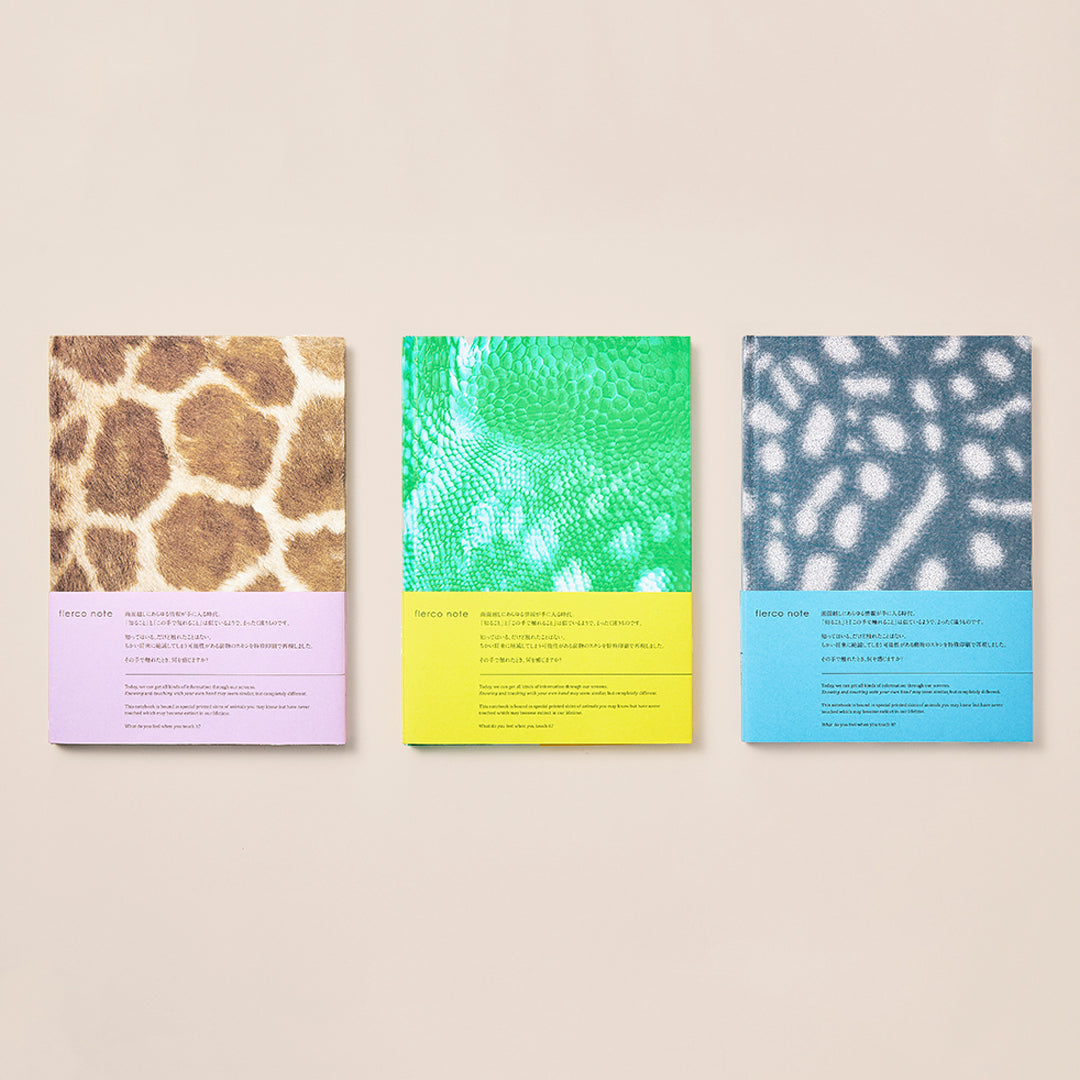
flerco note | A notebook that lets you touch endangered species
View product 〉
PRODUCTS








![[Made to order] Green Summer Wreath made with summer branches (fresh flowers)](http://sikito.com/cdn/shop/files/20250702_-15.jpg?v=1751530871&width=900)




![[Made to Order] Four Seasons and Bonsai: Summer | Japanese Maple](http://sikito.com/cdn/shop/files/yomimono20250912.jpg?v=1756106914&width=900)
![[Pre-Order] Seasons and Bonsai: Summer | Gardenia](http://sikito.com/cdn/shop/files/DSC09951a.jpg?v=1779693971&width=900)
![[Made to Order] Seasons and Bonsai: Summer | Crape Myrtle](http://sikito.com/cdn/shop/files/DSC0468_2.jpg?v=1779774773&width=900)
We also recommend this article


