

Asking an Architect and Space Producer About the Appeal of "Branches"

An interview with Rie TANAKA, a licensed first-class architect who also serves as the representative director of &R Architectural Design Co., Ltd.
Rie handles comprehensive design, including not only residential buildings but also restaurant and various salon design projects, as well as spatial production encompassing interiors and displays. We asked Rie about the charm of branches and their significance in the architectural design industry.
The appeal of branches from a first-class architect's perspective

—What do you think is the appeal of branches, Rie?
Sometimes I give them as seasonal gifts when I'm invited to someone's home. With flowers, depending on the type, they can be difficult to care for and lose their freshness in a week or two. Branches, however, last about a month, so you can enjoy them for a long time, and their simplicity makes them easy to blend into any room.
For example, I think it's wonderful to enjoy the passage of time by giving plum or cherry blossoms in bud form and watching them bloom, and then watching the petals flutter down.

—Do you often decorate your home with branches, Rie?
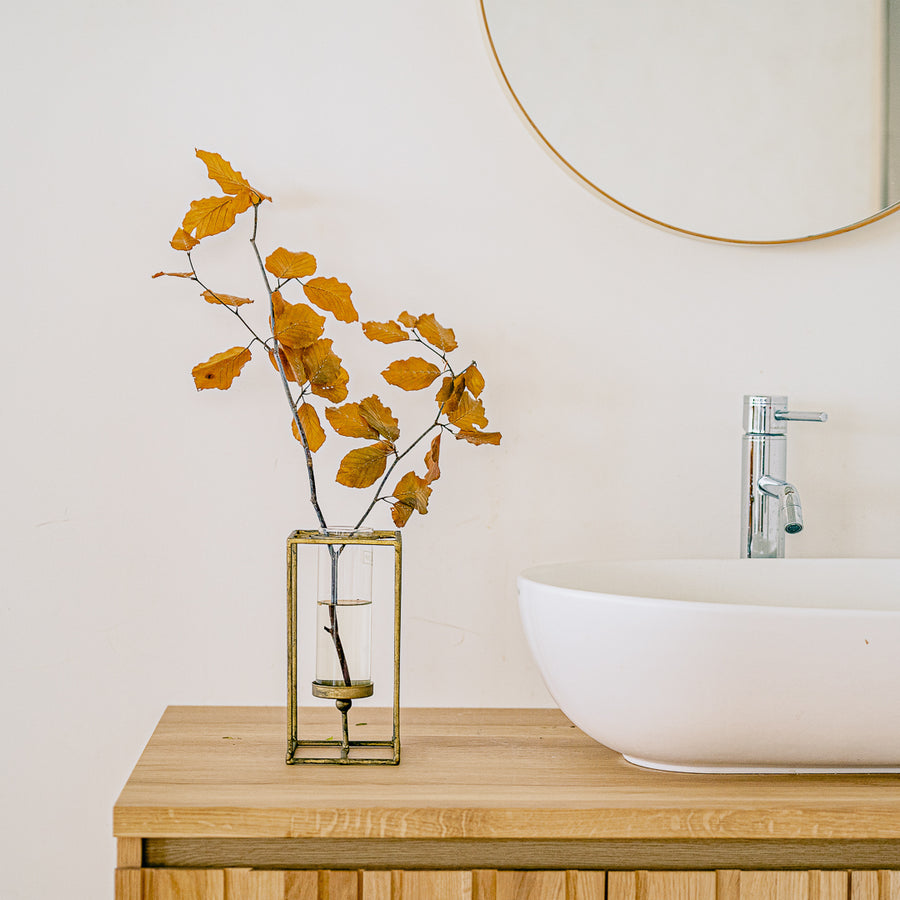
I often do. I also enjoy the time I spend buying large branches, pruning them in parts, and arranging them beautifully. I also arrange the trimmed branches in small vases.
—Do you have any tips for incorporating branches into interior design?
I often choose things that evoke a sense of the season. It's also lovely when the leaves fall or change color, and how that changes the expression of the space is also wonderful.
They are easy to display at home as part of the interior because they suit both Western and Japanese-style rooms, and I often use them when producing spaces.

—When do you use them in your work?
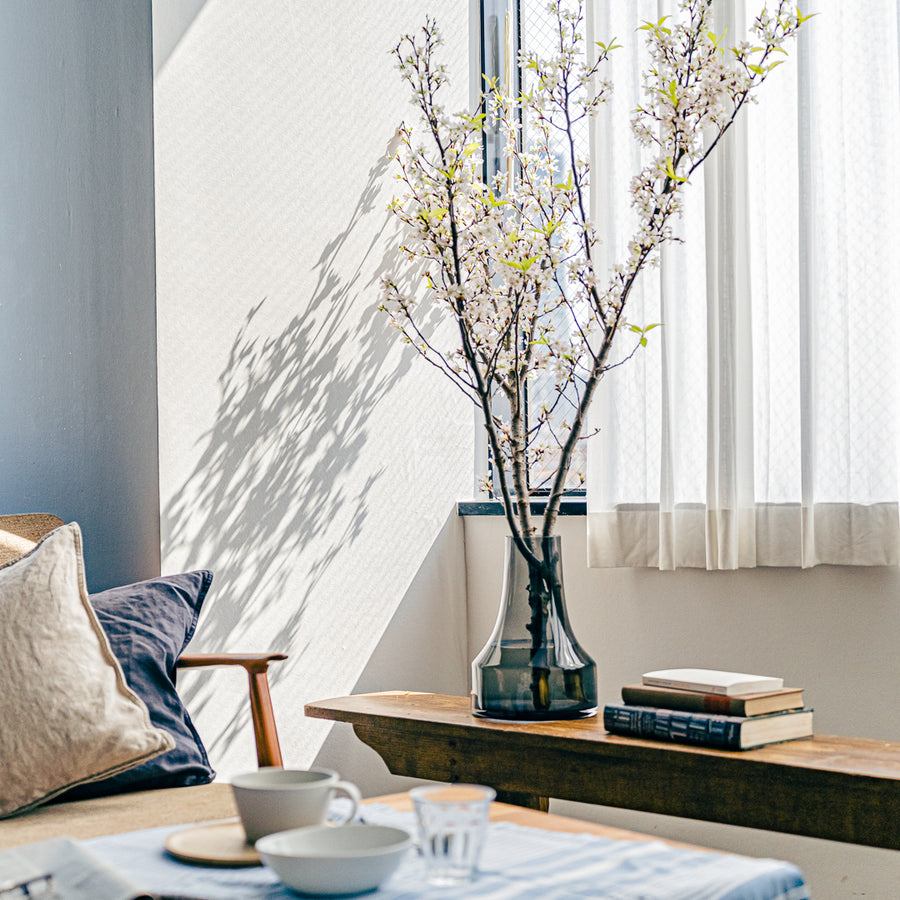
As interior accents, I sometimes make large and impactful branches the centerpiece to catch the eye, or I arrange smaller branches individually in multiple simple vases to serve as brilliant supporting actors that illuminate a corner.
—So, they're like an accent in the interior?
That's right. Interiors are often made of artificial materials, so many things are linear, and even if they are curved, they are drawn by human hands. When natural branches are introduced, a contrast effect is created, and I feel that it brings a beautiful sense of unity.
Rising demand for branches in the interior industry

With the rise of social media, influencers who share their lifestyles have emerged, and more people are posting photos of their home interiors. Among these posts, I often see photos featuring plants.
Especially for those living in urban areas, many may not have a garden. In such cases, even in the limited space of a home, many people seem to enjoy the pleasure of experiencing the seasons by placing plants, though calling it an "original garden" might be an exaggeration.
—When we visited Professor Chizuko Mizuniwa of Tokyo University of Agriculture, who specializes in landscaping and green environments, we also heard her say that "incorporating plants into your home leads to mental healing" [*].
That's definitely true, isn't it? When you have plants in your home, they require at least some care, but even that time feels precious.
Many of us, including myself, often feel like we're constantly being chased by "I have to do this, I have to do that," but when you water plants or touch the soil, you can become completely absorbed. I think that kind of "time spent deliberately putting in effort" is a good thing.

In terms of movements, another trend recently is the "Japandi" style, which fuses the minimalist qualities and beauty of Scandinavia and Japan.
For example, you might have a tatami space with Nordic textiles, or shoji screens used as partitions in a bedroom with a bed. In such settings, branches seem to blend in easily as an accent in the space.
[*] Read the article here: 【The comfort of branches】Branches that bring the seasons become a 'garden' inside the house)
—The interior of the new SiKiTO cafe also combines Western and Japanese styles, and branches suit it very well. What is the background behind the popularity of the "Japandi" style?
Architectural trends sometimes reflect current events. For a while now, due to the influence of COVID-19, "time at home" has been re-evaluated. I think a significant factor is that comfort has become more important.
When people want to "relax at home," I feel that more people prefer carpets, tatami mats, or linen materials. The fact that plants fit well with this is probably one of the reasons for the popularity of branches.

SiKiTO CAFE, which opened in Makuhari in September 2024
(web page here)
Also producing cafes that feature plants

(Photo: Kazufumi Shimoyashiki)
—I heard that you recently designed and styled a cafe decorated with plants.
That's right. The owner simply loves plants.
People who come to the cafe sometimes look at the plants, and people who come to see the plants sometimes use the cafe. It's similar to SiKiTO CAFE in that one can be a trigger for attention to the other, isn't it?
In this cafe, original potted arrangements serve as the interior decor of the shop, and if you like them, you can purchase them. We also plan to hold workshops on potted arrangements.
—Conversations would likely flow easily through plants.
There are not many cafes in the area, so many people were looking forward to its opening even before it opened. The types of plants change with each season, so I think people can enjoy it no matter how many times they visit.
Having plants adds warmth to the interior, and it would be great if people could enjoy the effort of maintaining them as well.

—Finally, what do you think will happen with branches in the future?
The relationship between architecture and nature is an eternal theme, so in that sense, incorporating nature into space will remain constant.
I believe the demand for flowers and plants, including branches that allow people to feel nature at home, will only grow stronger.
Rie, who spoke about the appeal of branches from the perspective of an interior design professional.
She taught us that branches, as a "natural element" that evokes seasonality in both Japanese and Western styles, still hold immense potential.
SiKiTO will continue to bring wonderful encounters with branches to many more people.
Profile | Rie TANAKA

Representative Director of &R Architectural Design Co., Ltd. / First-class architect / Designer
Born in Hokkaido. After working at design offices in Sapporo, Osaka, and Tokyo, she became independent in 2020. She focuses on architectural design and comprehensive design, including spatial production encompassing furniture, logos, and displays. She receives continuous requests from individuals to corporations across the country.

枝もの定期便|自宅で待つだけ、飾るだけ。
商品をみる 〉
PRODUCTS
![[Made to order] Green Summer Wreath made with summer branches (fresh flowers)](http://sikito.com/cdn/shop/files/20250702_-15.jpg?v=1751530871&width=900)

![[Made to Order] Four Seasons and Bonsai: Summer | Japanese Maple](http://sikito.com/cdn/shop/files/yomimono20250912.jpg?v=1756106914&width=900)
![[Pre-Order] Seasons and Bonsai: Summer | Gardenia](http://sikito.com/cdn/shop/files/DSC09951a.jpg?v=1779693971&width=900)
![[Made to Order] Seasons and Bonsai: Summer | Crape Myrtle](http://sikito.com/cdn/shop/files/DSC0468_2.jpg?v=1779774773&width=900)
We also recommend this article


Characteristics and display of Pussy Willow: a branch with cat tail-like catkins
A deciduous shrub of the genus Salix ...


