

16 Spring Branches | Recommended Varieties to Enjoy Beautiful Flowers and New Growth, and Their Flower Meanings

Spring is a season where flowers bloom and the colors of new growth gently spread. Spring branches that evoke this season add color to your daily life.
This article introduces 16 recommended types of branches that offer not only visual beauty but also fragrance and foliage.
Why not incorporate these branches, which will bring a touch of spring to your room, into your daily life?
- The Appeal of Branches
- 16 Recommended Spring Branches
- Japanese Quince (Boke)
- Keiozakura Cherry
- Wintersweet (Robai)
- Acacia
- Spiraea (Kodamari)
- Cornelian Cherry (Sanshuyu)
- Magnolia (Mokuren)
- Snow Willow (Yukiyanagi)
- Forsythia (Rengyo)
- Red Kirishima Azalea (Benikiritsutsuji)
- Kawazu-zakura Cherry
- Flowering Peach (Hanamomo)
- Tanashi Azalea (Tanashi-tsutsuji)
- Judas Tree (Hanazuou)
- White Witch Hazel (Shirobana Mansaku)
- Dwarf Fothergilla (Hime Mizuki)
- "Branch Subscription Service" to Feel the Arrival of Spring at Home
- Conclusion
The Appeal of Branches

Branches offer various charms. Here are three main appeals.
Feel the Seasons
Branches allow you to experience the changing seasons even while indoors, through the coloring of their flowers and leaves, and the way their fruits appear.
In spring, fresh branches with new buds; in summer, cool, leafy branches; in autumn, colorful foliage and berries; and in winter, simple branches. Life with branches brings comfort and warmth to your home.
Just by decorating your room, a sense of connection with the outdoors permeates the space, allowing you to incorporate the rhythm of nature into your life.
Easy to Care for and Long-lasting
Branches typically last longer than cut flowers.
With proper care, many varieties can stay beautiful for several weeks, and some can even be enjoyed for several months.
Another attractive aspect of branches is that the water stays cleaner compared to flowers, so frequent water changes are not necessary.
Blends with Any Interior Style
The charm of branches is their ability to blend seamlessly with any interior style, whether natural, Nordic, or modern Japanese.
While having a substantial presence, they don't overpower, instead enhancing the "whitespace" of the room.
Even just one or two branches in a vase can create a stylish atmosphere, effortlessly elevating your space.
16 Recommended Spring Branches
Decorating with different branches each season can further enhance your interior. Here are some recommended branches for spring.
1. Japanese Quince (Boke)

|
Availability Period |
November–January |
|
Supply Level |
★★★☆☆ |
|
Longevity |
★★★☆☆ |
Japanese quince is a branch that blooms with charming, plum-like flowers from early spring to spring.
It is characterized by its vibrant flower colors and rounded shape, and has long been cherished as a garden tree, potted plant, and bonsai. Its thorny branches are also used as hedges to prevent intrusion.
Its name is said to have originated from the gourd-like shape of its fruit, which was called "moke," later evolving into "boke."
Its flower meanings include "pioneer," "precocity," "ordinariness," and "passion." Its appearance, signaling the arrival of spring, will add color and a sense of the season to your life.

Characteristics and Displaying of Japanese Quince (Boke)
Read Article 〉
2. Keiozakura Cherry

|
Availability Period |
December–March |
|
Supply Level |
★★★★★ |
|
Longevity |
★★★★☆ * If kept in a warm room, buds will bloom into flowers within a few days, but you can enjoy the progression from flower to fresh green leaves for a long time. |
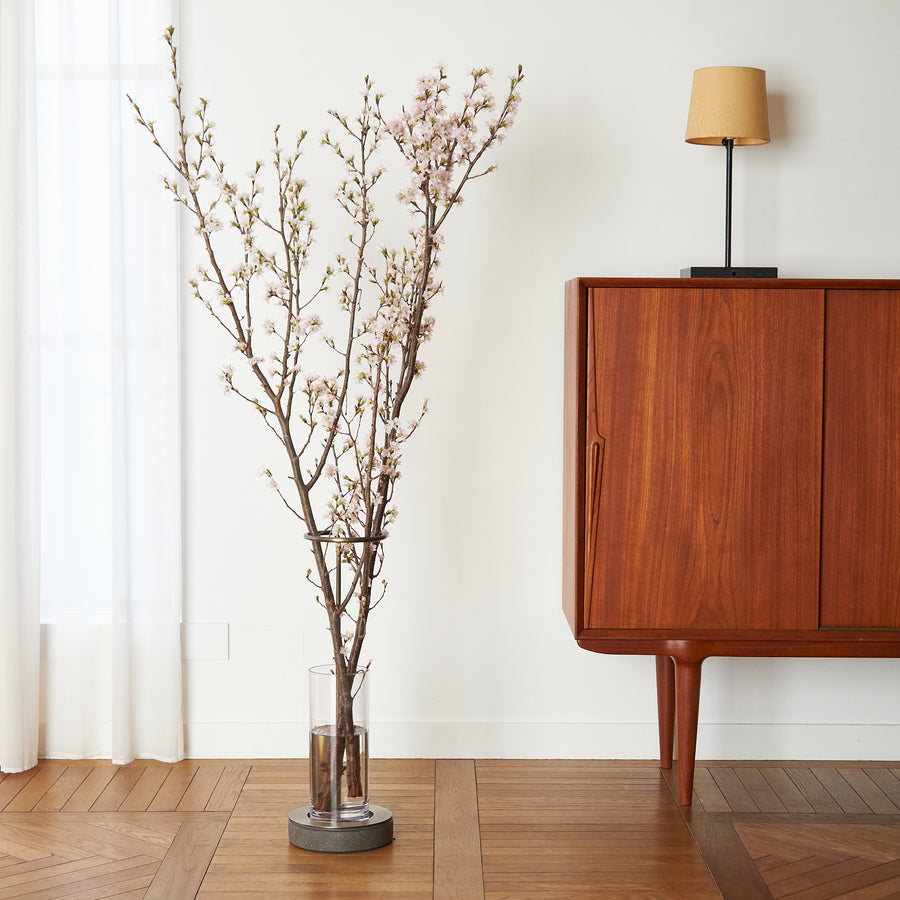
Keiozakura is an early-blooming cherry variety that produces delicate pale pink flowers on slender branches. Unlike the thick, strong trunks of Someiyoshino, its modest and gentle appearance exudes elegance.
As it blooms earlier than common cherry blossoms, usually in mid-March, it often appears at graduation and entrance ceremonies as a "harbinger of spring."
Its flower meanings include "purity" and "spiritual beauty," making it a perfect gift for special occasions. When enjoying Keiozakura at home, it is recommended that the branches be about twice the height of the vase.

Characteristics and Displaying of Keiozakura Cherry
Read Article 〉
3. Wintersweet (Robai)

|
Availability Period |
December–January |
|
Supply Level |
★★★☆☆ |
|
Longevity |
★★★☆☆ |
Wintersweet is a branch that blooms early in the cold of winter.
It is said to have arrived in Japan from China in the early Edo period, and because it blooms even in snow, it has been praised as one of the "Four Friends of Winter" along with plum, camellia, and narcissus.
Its petals are delicate like waxwork, characterized by a translucent pale yellow. Its subtly sweet and elegant fragrance is also one of its charms, making it a branch that allows you to experience the season not only visually but also through scent.
4. Acacia

|
Availability Period |
January–March |
|
Supply Level |
★★★★★ |
|
Longevity |
★★☆☆☆ |
Acacia, which signals the arrival of spring, is widely known as "mimosa" in Japan. It is also known as a symbol of International Women's Day (March 8th).
Acacia is a plant native to Australia, and in spring, it blooms with fluffy yellow tiny flowers. Its vibrant colors and lovely appearance brighten the hearts of those who see it, earning it the name "flower of happiness."
Furthermore, acacia carries beautiful flower meanings such as "elegance," "gratitude," and "compassion." It is a perfect branch for gifts to loved ones or for spring interior decoration.
5. Spiraea (Kodamari)

|
Availability Period |
January–March |
|
Supply Level |
★★★★★ |
|
Longevity |
★★☆☆☆ |
This branch is beautiful with its small, fluffy flowers arranged densely along the branches, resembling tiny temari balls. As its name suggests, the charm lies in its round, lovely flower shape.
It has a history of being cherished as an ornamental plant since the Edo period, and it beautifully adorns the arrival of spring. Despite its delicate appearance, its branches have a strong presence.
Its flower meanings include "friendship," "effort," "elegance," and "refinement," making it a branch that adds splendor to spring interiors.

Characteristics and Displaying of Spiraea (Kodamari)
Read Article 〉
6. Cornelian Cherry (Sanshuyu)

|
Availability Period |
January–March |
|
Supply Level |
★★☆☆☆ |
|
Longevity |
★★★☆☆ |
In early spring, this branch blooms with tiny yellow flowers all over its branches before the leaves emerge. Although each flower is modest, the sight of about 30 small flowers clustered together to form an inflorescence at the tips of the branches is striking.
Known as "Haru Koganebana" (Spring Golden Flower) due to its radiant blossoms, it has long been cherished as a garden tree, in Japanese gardens, and as a park tree.
Cornelian cherry has flower meanings of "persistence" and "durability." Its vigorous blooming after enduring a harsh winter embodies both delicate beauty and inner strength.
7. Magnolia (Mokuren)

|
Availability Period |
January–February |
|
Supply Level |
★☆☆☆☆ |
|
Longevity |
★★★★☆ |
Magnolia is a beautiful branch that produces large flowers facing upwards, heralding the arrival of spring. It has long been cherished not only for its ornamental value but also as a medicinal herb.
With a height that can reach 20m, its presence is overwhelming. The buds are wrapped in soft silver fur, allowing for an elegant appreciation even before the flowers open.
One of its charms is the opportunity to slowly enjoy the transition from bud to full bloom.
8. Snow Willow (Yukiyanagi)

|
Availability Period |
January–March |
|
Supply Level |
★★★★☆ |
|
Longevity |
★★☆☆☆ |
Snow willow is a branch that blooms with tiny white flowers all over its gracefully drooping, willow-like branches.
Modest yet strikingly beautiful, snow willow dyes parks and gardens pure white when in bloom, brightly adorning the spring landscape.
Its flower meanings include "loveliness," "whim," "nobility," and "quiet thoughts," conveying delicate and reserved sentiments.

Characteristics and Displaying of Snow Willow (Yukiyanagi)
Read Article 〉
9. Forsythia (Rengyo)

|
Availability Period |
January–March |
|
Supply Level |
★★★★☆ |
|
Longevity |
★★★☆☆ |
Forsythia is a branch that vividly announces the arrival of spring.
Also known as "Golden Bell" in English, its name accurately describes its striking appearance, with bell-shaped yellow flowers covering its branches.
Its flower meanings include positive sentiments such as "hope," "expectation," and "concentration," making it a recommended branch to accompany the start of a new season.

Characteristics and Displaying of Forsythia (Rengyo)
Read Article 〉
10. Red Kirishima Azalea (Benikiritsutsuji)

|
Availability Period |
January–April |
|
Supply Level |
★★☆☆☆ |
|
Longevity |
★★★☆☆ |
Benikiritsutsuji is a branch that exudes strength from its firm foliage, yet when it blooms, it evokes a somewhat nostalgic atmosphere.
While azaleas are commonly seen as garden trees, it is not often available as a cut branch. Therefore, encountering it in bloom is a precious opportunity.
The kanji for "tsutsuji" (azalea) includes the character for "foot," which is said to derive from "being so beautiful one involuntarily stops to gaze at it."
True to this saying, the Benikiritsutsuji flower will instantly beautify any room it is displayed in.
11. Kawazu-zakura Cherry

|
Availability Period |
February–March |
|
Supply Level |
★☆☆☆☆ |
|
Longevity |
★★★☆☆ |
Kawazu-zakura is a Japanese native cultivar born from the natural cross-pollination of Oshima cherry and Taiwan cherry.
It is cherished as an early-blooming cherry blossom, flowering from around February, thus heralding the arrival of spring a little earlier. It produces flowers that are slightly darker pink than Someiyoshino.
It is a branch that allows you to enjoy the beauty of fresh green leaves after the blossoms fade. Its flower meanings include "entrusting thoughts," "purity," and "spiritual beauty," making it perfect for expressing gratitude or sentiments.
12. Flowering Peach (Hanamomo)

|
Availability Period |
February–March |
|
Supply Level |
★★★★★ |
|
Longevity |
★★☆☆☆ |
Flowering peach is a type of peach cultivar specifically bred for its blossoms.
It is a flower that has long been intertwined with Japanese life, with records indicating it was already displayed for "Hina Matsuri" (Doll's Festival) in the Heian period, making it a branch cherished for centuries.
Its blooming flowers come in pink, red, and white, with some branches even displaying both red and white blossoms. The richness of its colors will surely brighten the hearts of those who behold them.
13. Tanashi Azalea (Tanashi-tsutsuji)

|
Availability Period |
March–April |
|
Supply Level |
★★☆☆☆ |
|
Longevity |
★★★☆☆ |
"Tanashi Azalea" is a branch named after the Tanashi district of Nishitokyo City, Tokyo.
While opportunities to see it have decreased with urban expansion, it still preserves the history and beauty that once rooted in this land.
The sight of small, lovely red flowers blooming profusely on its branches is somewhat nostalgic and brings a sense of calm just by looking at it.
14. Judas Tree (Hanazuou)

|
Availability Period |
March–April |
|
Supply Level |
★☆☆☆☆ |
|
Longevity |
★★★☆☆ |
"Hanazuo" (Chinese Redbud) is a branch flower that blooms with dense clusters of small, reddish-purple or pink flowers along its branches. Its name comes from the color of the flowers, which resembles the suou (sappanwood) tree used for dye.
Another charm of this plant is the cute heart-shaped leaves that appear after the flowers have bloomed.
Its flower meanings include "awakening," which is said to derive from the vibrancy that heralds the arrival of spring.
15. White Witch Hazel

|
Availability Period |
April |
|
Availability Volume |
★☆☆☆☆ |
|
Longevity |
★★★★☆ |
"White Witch Hazel" is a branch flower with a unique white pom-pom-like appearance that makes a significant statement.
There are several theories about the origin of the name "Mansaku." Some say it's a corruption of "mazu saku" (blooms first) or "massaki" (first of all). Others suggest it comes from "mansaki" (full bloom) due to the abundance of flowers, or from "mannen housaku" (ten thousand years of good harvest) because of the bountiful golden flowers of some varieties.
It has been cherished by people since ancient times and is known as an auspicious flower that heralds the beginning of spring.
16. Hime Mizuki (Dwarf Dogwood)

|
Availability Period |
May-June |
|
Availability Volume |
★★★☆☆ |
|
Longevity |
★★★☆☆ |
"Hime Mizuki" is a branch flower with chubby, adorable heart-shaped leaves.
After the flowers scatter, it is often distributed as a foliage branch from May to June, and it is a plant that allows you to enjoy natural greenery among branch flowers.
The tips of the leaves sometimes have a faint reddish hue on the new buds, and this subtle color gradation is eye-catching.
"Branch Flower Subscription" to feel the arrival of spring at home

For those who want to enjoy seasonal branch flowers more easily, SiKiTO's "Branch Flower Subscription" is also recommended.
Seasonal branch flowers are delivered to your home every month, allowing you to feel the changing seasons each time you display them.

Branch Flower Subscription | Seasonal Branch Flowers Delivered to Your Home
View Products 〉

【Featured Page】
List of Vases Recommended for Branch Flowers
View Page 〉
Summary
Spring branch flowers, simply by being displayed, bring a gentle sense of spring's arrival into your space. Even a single branch is beautiful and elegant, adding color and peace of mind to your daily life.
Why not welcome your favorite branch into your home and slowly savor the arrival of spring?
PRODUCTS


![[Made to order] Green Summer Wreath made with summer branches (fresh flowers)](http://sikito.com/cdn/shop/files/20250702_-15.jpg?v=1751530871&width=900)


![[Made to Order] Four Seasons and Bonsai: Summer | Japanese Maple](http://sikito.com/cdn/shop/files/yomimono20250912.jpg?v=1756106914&width=900)
![[Pre-Order] Seasons and Bonsai: Summer | Gardenia](http://sikito.com/cdn/shop/files/DSC09951a.jpg?v=1779693971&width=900)
![[Made to Order] Seasons and Bonsai: Summer | Crape Myrtle](http://sikito.com/cdn/shop/files/DSC0468_2.jpg?v=1779774773&width=900)
We also recommend this article

If you want to express your gratitud...

Branch Decor for New Homes: Stylish Arrangements and Examples
If you're looking to incorporate gre...


