

Characteristics and Displaying of Flowering Quince | A branch flower that blooms with red, plum-like flowers in early spring

About flowering quince (Boke)
| Plant name | Flowering quince (Boke) |
| Scientific name | Chaenomeles speciosa |
| English name | Japanese quince, Japonica, Chinese flowering quince |
| Family/Genus | Rosaceae / Chaenomeles |
| Classification | Deciduous / Shrub |
| Origin | China |
| Availability | November to January |
| Longevity | ★★★☆☆ |
| Market volume | ★★★☆☆ |
*Ratings are on a 5-point scale
Characteristics of flowering quince
Flowering quince is a deciduous shrub belonging to the Rosaceae family. It is popular as a bonsai, garden tree, or potted plant due to its beautiful, plum-like flowers that bloom from early spring to spring. Its branches have sharp thorns, so it has also been used as a hedge.
It is said that the name "Boke" (木瓜) originated from the fruit's resemblance to a gourd ("moke" -> "boke").
Originating in China, it was introduced to Japan during the Heian period and cultivated for ornamental purposes. Through selective breeding, it is now said to have over 200 varieties.
In autumn, it bears yellowish-green fruits that are fragrant and sometimes used to make jam or fruit liqueur.
Flowering quince has been deeply rooted in Japanese gardens and culture since ancient times due to its beauty and practicality.

Language of flowers for flowering quince
The language of flowers for flowering quince includes "pioneer," "precocity," "ordinariness," and "passion."
"Pioneer," "precocity"
The flower meanings "pioneer" and "precocity" come from its Chinese name, "Fangchunhua" (放春花). Fangchunhua means "the flower that ushers in spring early." It's a perfect flower meaning for the flowering quince, which releases the scent of spring before any other flower.
Additionally, the flowering quince flower is said to be featured in the family crest of Oda Nobunaga, a Sengoku period warlord. It can be said to be a suitable flower meaning for a leader who inspires and guides people.
"Ordinairness"
Flowering quince, with its thorny branches, was used as a hedge in many homes. Also, because it doesn't grow very large (2-3 meters), it's suitable for small gardens. This is said to be the origin of the flower meaning "ordinariness."
"Passion"
The flower meaning "passion" was given to the flowering quince due to its vibrant red flowers. As mentioned earlier, the flowering quince is also a motif in the Oda clan's family crest. "Passion" also evokes the fervent spirit of Sengoku warlords.
How to display flowering quince

Flowering quince is called "inverted branch," and some branches point upwards while others point downwards, creating a very random, "wild" arrangement. The pleasure of displaying flowering quince lies in how well you manage these branches.
For the branch subscription service, our florists prune the branches before delivery, so even the somewhat difficult branches of flowering quince are easier to arrange. Rest assured!
Also, by displaying it in the EDA VASE specifically designed for branches, it will be firmly supported, allowing the quince branches to be displayed neatly without getting wild. Please experience the joy of displaying moving branches.

EDA VASE | Compact vase for beautifully displaying branches
View product 〉
Interior examples with flowering quince
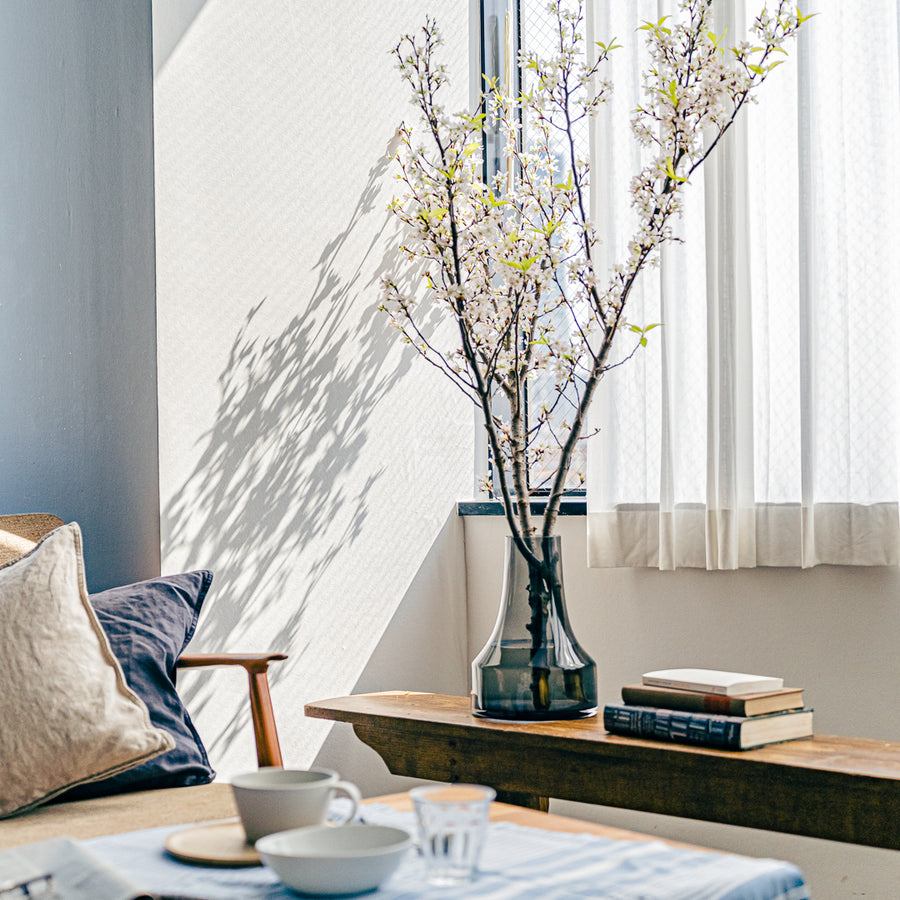
Originating from China, the flowering quince is a vibrant red flower with a strong presence. Since the flower itself is flamboyant, it would suit ceramic vessels in subdued colors or simple-shaped vases.
Additionally, using a clear glass vase allows you to see the water and branch lines, creating a cooler impression.
Precautions when arranging in a vase
When arranging in a vase, it is important to consider the overall balance and cut the branches to fit the vase. If left too long, the branches may spread out and become unruly.
"Mizage" (water absorption), which involves cutting the bottom 2-3 cm of the stem diagonally, is also crucial. This extra step increases the surface area exposed to water, allowing the branches to last longer.
When cutting branches, try using pruning shears designed for branches and woody plants.

Toyama Hamono | Pruning shears that last a lifetime and can cut thick branches
View product 〉
How to care for flowering quince
Flowering quince is a sturdy branch that is often used as a garden tree, but sometimes buds or flowers may fall off, so be careful. In addition, daily care is important to enjoy quince branches for a longer time!
Here are some basic care tips for branches.
Basic Care
1. Recutting upon receipt

Upon receipt, recut the branches before arranging them in a vase.
At this time, make a cross-shaped cut at the base and peel off the bark to help the branch absorb water more easily.
To enjoy branches for longer, consider using a floral preservative in the water. It can prevent the vase water from getting dirty and keep the flower colors vibrant, which is expected to help the branches last longer.
■Freshness preserver to nourish branches

Would you like to try a freshness preserver to provide necessary nutrients to your branches and keep your vase water clean? It has the effect of dissolving the sap at the cut end to improve water absorption, allowing you to enjoy your branches for longer.
Branch-specific freshness preservers are available here.
■Florist knife for better water absorption

By stripping the bark from the part submerged in water, plants can absorb water more easily, which is expected to help the branches last longer.
For stripping bark, we recommend using a specialized sharp knife. Check out the VICTORNINOX florist knife here.
Its quality is trusted by professionals worldwide.
2. Place the branches in a comfortable spot
Avoid placing branches where they will be directly exposed to air conditioning. It is best to place them in a well-ventilated and cool location.
They are also cold-hardy, so it is fine to place them outdoors, such as by the front door. Avoid direct sunlight and find a comfortable spot for your branches.
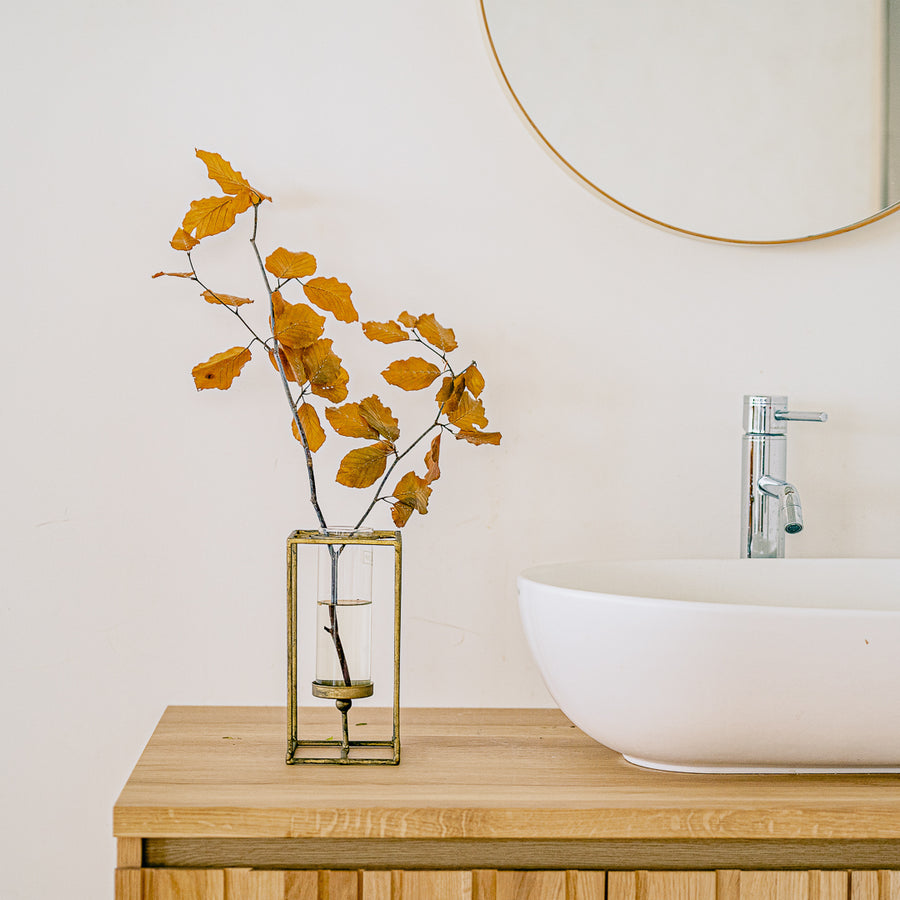
They have a significant presence that can change the impression of any space, whether it's the living room, entryway, or kitchen. It's also recommended to decorate your bedroom or bathroom with them.
3. Change the water frequently

Change the water frequently before it becomes cloudy.
With the EDA VASE mentioned above, the base is made of polycarbonate, which is lighter and more durable than glass, making water changes easy.
If your branches are looking wilted...
Cut them shorter and arrange them in a small vase to enjoy

While many branches last relatively long, over time, they inevitably become less able to absorb water. If you notice your branches looking a bit wilted, try cutting them shorter and arranging them in a smaller vase.
Cutting them shorter will help them absorb water more easily, and arranging them in a small vase offers a different way to enjoy them!
Flowering quince trivia

Flowering quince in the Oda clan's family crest
"Oda Mokko Mon" (Oda Flowering Quince Crest) is the most well-known family crest of the Oda clan.
It features five flower pillars surrounded by five petals, forming a well-balanced single large flower design.
The "Mokko Mon" (flowering quince crest), which is the basis of the Oda Mokko, is one of Japan's family crests, mainly known for its abstract design representing the fruit or cross-section of the flowering quince. Its origin is said to have been introduced from Tang (China) during the Nara period, and it is a family crest with deep historical significance.

Flowering quince as an exorcism charm
Since ancient times, flowers with five petals have been likened to a pentagram and believed to have the power to ward off evil and evil spirits.
The flowering quince flower is a prime example, used as a flower with the power to ward off evil due to its five petals.
Not only its petal shape but also the jagged leaves and thorny branches were believed to have the power to repel evil spirits, and it was often planted around gardens and homes as a "plant that keeps evil spirits away."
It has a history of being cherished not only for its beautiful appearance but also as a charm to protect families and homes.
Summary of flowering quince

Flowering quince is a deciduous shrub belonging to the Rosaceae family. It has been cherished as a bonsai, garden tree, and potted plant for its beautiful, plum-like flowers that bloom from early spring to spring. Its branches have sharp thorns, so it is also used as a hedge.
Its flower meanings include "pioneer," "precocity," "ordinariness," and "passion."
It was also used as an exorcism charm due to the shape of its petals. Flowering quince has been deeply rooted in Japanese gardens and culture since ancient times, thanks to its beauty and practicality.

【SiKiTOのよみもの】枝もの図鑑
よみもの一覧をみる〉

枝もの定期便|自宅で待つだけ、飾るだけ。
商品をみる 〉
PRODUCTS
![[Made to order] Green Summer Wreath made with summer branches (fresh flowers)](http://sikito.com/cdn/shop/files/20250702_-15.jpg?v=1751530871&width=900)
![[Made to Order] Four Seasons and Bonsai: Summer | Japanese Maple](http://sikito.com/cdn/shop/files/yomimono20250912.jpg?v=1756106914&width=900)
![[Pre-Order] Seasons and Bonsai: Summer | Gardenia](http://sikito.com/cdn/shop/files/DSC09951a.jpg?v=1779693971&width=900)
![[Made to Order] Seasons and Bonsai: Summer | Crape Myrtle](http://sikito.com/cdn/shop/files/DSC0468_2.jpg?v=1779774773&width=900)
We also recommend this article


A year has passed in a flash since I ...


%0A%0A%0A%0A%0A%0A%0A%0A%0A%0A%0A%0A%0A%0A%0A%0APlant%20name%0A%0AFlowering%20quince%20(Boke)%0A%0A%0A%0A%0A%0A%0AScientific%20name%0A%0AChaenomeles%20speciosa%0A%0A%0A%0A%0A%0AEnglish%20name%0A%0AJapanese%20quince,%20Japonica,%20Chinese%20flowering%20quinc...)