

Characteristics and Display of Kawazu-zakura Cherry Blossoms | Early-Blooming Cherry Blossoms in Kawazu Town, Shizuoka Prefecture

Basic Information about Kawazu-zakura (Kawazu Cherry Blossoms)
| Plant Name | Kawazu-zakura (Kawazu Cherry Blossoms) |
| Scientific Name | Cerasus ‘Kawadu-zakura’ |
| English Name | Kawazu zakura Cherry |
| Alternate Name | Minami-zakura |
| Family/Genus | Rosaceae / Prunus |
| Classification | Deciduous broadleaf / Tree |
| Origin | Japan |
| Availability | February - March |
| Longevity | ★★☆☆☆ |
*Ratings are on a 5-star scale
Characteristics of Kawazu-zakura
A deciduous broadleaf tree belonging to the rose family, genus Prunus. It is a Japanese native cultivated variety born from the natural cross-pollination of the indigenous Japanese species Oshima Cherry and Taiwan Cherry, and is known as an "early-blooming cherry blossom" that begins to bloom around February.
It was named after Kawazu Town in Izu, Shizuoka Prefecture, where it was discovered. The annual "Kawazu Cherry Blossom Festival" in Kawazu Town is also famous.
Compared to Somei-Yoshino, the flowers are a deeper color, making it a cherry blossom that vividly heralds the arrival of spring.
After the flowers fall, fresh green leaves emerge, allowing you to enjoy the fresh green foliage as well. The ability to enjoy the changing appearance is also one of the charms of cut branches.

Meaning of Kawazu-zakura
The meanings of Kawazu-zakura include "I entrust my feelings to you," "purity," and "spiritual beauty." Some cherry blossom varieties share these meanings.
"Purity"
"Purity" refers to a state of being unblemished and clean. This meaning was given because of the pure and beautiful, unadulterated pink and white flowers it produces.
"Spiritual Beauty"
This is said to be derived from the Western floral meaning "spiritual beauty."
There is an anecdote that when George Washington, the first president of the United States, was a child, he accidentally cut down a cherry tree that his father cherished. When he honestly confessed this, he was praised for his honesty instead.
Along with this episode, "spiritual beauty" was given as a floral meaning to represent not only its outward beauty but also its high spirituality and dignity, as a special flower.
"I entrust my feelings to you"
This is a floral meaning unique to Kawazu-zakura, unlike other cherry blossom varieties. The origin is not clear, but it is said to be because the deep pink flowers of Kawazu-zakura evoke strong feelings, hope, and expectations.
How to Display Kawazu-zakura

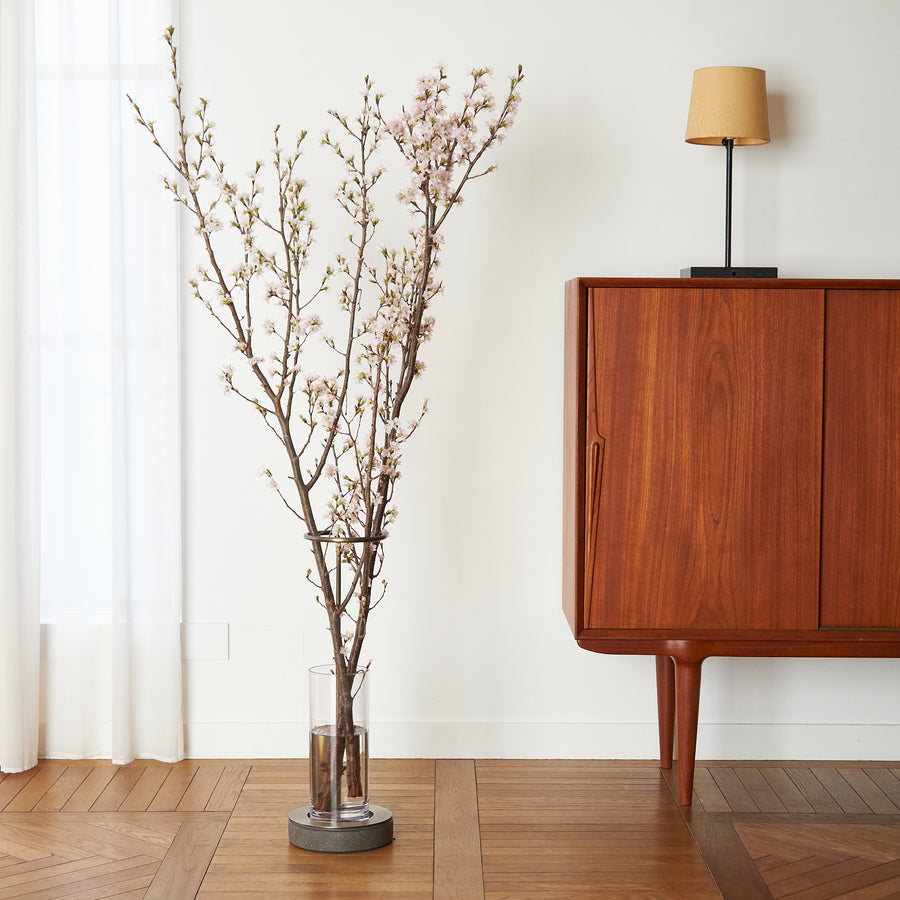
Kawazu-zakura is characterized by its wild, curving branches compared to Keio-zakura, which grows straight. It is advisable to use a stable vase, and if you are arranging several cherry blossom branches together, choose a vase with a wider opening to maintain balance.
To best showcase its voluminous feel, it is recommended to arrange the branches so that the vase and the branches are in a 1:2 ratio.
Try arranging the branches so they lean naturally into the vase.

EDA VASE | A compact vase for beautifully displaying cut branches
View Product >
Examples of Interiors Decorated with Cherry Blossoms
Using a transparent glass base gives a refreshing impression, as you can see the water and the lines of the branches.
On the other hand, arranging them in a ceramic or metal vase creates a slightly more subdued atmosphere. They also go well with Japanese-style interiors and natural aesthetics.
*Displays posts of Keio-zakura
Precautions when arranging in a vase
When arranging in a vase, it is important to consider the overall balance and cut the branches to fit the vase. If displayed too long, the branches may spread too wide and be difficult to manage.
"Mizukage" (re-cutting the stem underwater), where you cut the lowest 2-3 cm of the stem diagonally, is also important. A state of wilting due to lack of water is called "mizu ga sagatta," and "mizukage" refers to making it easier for the plant to absorb water to prevent this.
This extra step increases the surface area exposed to water, helping cut branches last longer. When cutting branches, it is recommended to use pruning shears designed for branches and woody plants.

Toyama Hamono | Pruning shears that can cut thick branches and last a lifetime
View Product >
How to care for Kawazu-zakura
Kawazu-zakura is a branch flower that can be enjoyed as fresh foliage even after its blossoms have fallen. To enjoy your cherry blossom branches for as long as possible, a little daily care is essential.
Here, we will introduce basic care methods for cut branches.
Basic Care
1. Re-cut the stems on the day of receipt.

Upon receipt, re-cut the stems before arranging them in a vase.
At this time, make a cross-shaped cut at the base and peel off the bark to make it easier for the branch to absorb water.
To enjoy cut branches longer, it is recommended to arrange them in water with a freshness preservative. This helps prevent the vase water from getting dirty and keeps the flower color vibrant, which can extend the life of the cut branches.
■ Freshness Preservative for Branches

Would you like to try a freshness preservative to provide essential nutrients to your branches and keep the vase water clean? It has the effect of dissolving sap at the cut end to improve water absorption, allowing you to enjoy your branches for longer.
You can find dedicated branch freshness preservatives here.
■ Florist Knife for Better Water Absorption

By peeling the bark from the part submerged in water, you can expect to improve water absorption. Check out the VICTORINOX florist knife here.
It offers reliable quality, trusted by professionals worldwide.
2. Display the branches in a comfortable spot.
Cut branches are best placed in a well-ventilated, cool location away from air conditioner drafts.
Avoid direct sunlight and try to find a comfortable spot for your branches.
They have a significant presence that can change the impression of any space, whether it's the living room, entrance, or kitchen. They are also recommended for bedrooms and washrooms.
3. Change the water frequently.

Change the water frequently before it becomes cloudy. At that time, re-cutting the stems will also help them absorb water again.
With the EDA VASE introduced above, the base is made of polycarbonate, which is lighter and more durable than glass, making water changes easy.
When your branches are wilting…
Enjoy them by cutting them into smaller pieces.

While many cut branches last relatively long, over time, it naturally becomes harder for them to absorb water. In such cases, try boldly cutting them shorter and arranging them.
Shorter pieces absorb water more easily, and arranging them in small vases can reveal a different charm.
Kawazu-zakura Trivia

Various Japanese Cherry Blossoms
Cherry blossoms are deciduous tall trees or shrubs belonging to the Rosaceae family, genus Prunus, and are widely distributed mainly in temperate regions of the Northern Hemisphere. Species that produce beautiful flowers are concentrated in Asia, particularly the Japanese archipelago.
In Japan, there are over 100 native cherry blossom varieties, including nine basic types such as Yamazakura and Oshimazakura, and their variants. Wild Taiwan Cherry can also be seen in Okinawa.
Furthermore, there are over 200 cultivated varieties developed from these. They each have unique characteristics, differing in flower color, size, and branch shape.
Among them, Kawazu-zakura is a cherry blossom born from the natural cross-pollination of the Taiwan Cherry lineage and early-blooming Oshima Cherry lineage, characterized by petals that are a deeper pink than Somei-Yoshino.
Cherry Blossoms Designated as Natural Monuments
They typically bloom from February to early March, about a month earlier than Somei-Yoshino. They are characterized by large flowers derived from Oshima-zakura and vibrant colors derived from Kanhi-zakura, with large purplish-red blossoms 4–5 cm in diameter.
The original Kawazu-zakura tree is said to have been discovered around 1955 by a town resident on the Kawazu River bank and planted in their garden.
It subsequently grew and spread magnificently within Kawazu Town, and in 2005, it was designated as a natural monument of Kawazu Town. The original tree still exists in this location, with an age of approximately 70 years, a height of about 10 meters, and a trunk circumference of 115 cm.
The Kawazu Cherry Blossom Festival Made Kawazu Town Famous
To allow more people to see the Kawazu-zakura, around 1975, the Kawazu Town Office, Chamber of Commerce and Industry, and local residents, led by the tourism association, planted several hundred cherry trees along the Kawazu River and near Kawazu Station on the Izu Kyuko Line.
As these cherry trees grew and bloomed profusely, the first "Kawazu Cherry Blossom Festival" was held in 1992.
Initially, the festival was small, with about 3,000 attendees, but its vivid beauty quickly gained recognition. By the 6th festival in 1996, it attracted 100,000 visitors, and by the 9th festival in 1999, over a million tourists visited Kawazu Town.
Today, approximately 8,000 magnificent Kawazu-zakura trees can be admired throughout Kawazu Town.
Kawazu Town, once an unknown tourist destination, rose to fame thanks to the emergence of a new cherry blossom variety and the dedicated efforts of its local residents.
Summary of Kawazu-zakura

Kawazu-zakura is a type of cherry blossom known as an "early-blooming cherry blossom" discovered in Kawazu Town, Izu, Shizuoka Prefecture. It was born from the natural cross-pollination of the Japanese native Oshima-zakura and Kanhi-zakura. Compared to Somei-Yoshino, its flowers have a deeper color.
The "Kawazu Cherry Blossom Festival," where 8,000 cherry trees can be admired in Kawazu Town, is also famous.
Its meanings include "I entrust my feelings to you," "purity," and "spiritual beauty."
Kawazu-zakura, which can also be enjoyed as fresh foliage after its blossoms fall, is a cut branch that can be enjoyed for a long time as the seasons change.

【SiKiTOのよみもの】枝もの図鑑
よみもの一覧をみる〉

枝もの定期便|自宅で待つだけ、飾るだけ。
商品をみる 〉
PRODUCTS

![[Made to order] Green Summer Wreath made with summer branches (fresh flowers)](http://sikito.com/cdn/shop/files/20250702_-15.jpg?v=1751530871&width=900)


![[Made to Order] Four Seasons and Bonsai: Summer | Japanese Maple](http://sikito.com/cdn/shop/files/yomimono20250912.jpg?v=1756106914&width=900)
![[Pre-Order] Seasons and Bonsai: Summer | Gardenia](http://sikito.com/cdn/shop/files/DSC09951a.jpg?v=1779693971&width=900)
![[Made to Order] Seasons and Bonsai: Summer | Crape Myrtle](http://sikito.com/cdn/shop/files/DSC0468_2.jpg?v=1779774773&width=900)
We also recommend this article


[Partial release for free] "Edamono Book Pre-order Campaign" with prizes ending soon!
Hello, this is Sato, representat...


%0A%0A%0A%0A%0A%0A%0A%0A%0A%0A%0A%0A%0A%0A%0A%0APlant%20Name%0A%0AKawazu-zakura%20(Kawazu%20Cherry%20Blossoms)%0A%0A%0A%0A%0A%0A%0AScientific%20Name%0A%0ACerasus%20%E2%80%98Kawadu-zakura%E2%80%99%0A%0A%0A%0A%0A%0A%0AEnglish%20Name...)