

Spirea Characteristics and Display | A Branching Plant with Small, Snow-like White Flowers

Basic Information about Spiraea thunbergii (Yuki-Yanagi)
| Plant Name | Spiraea thunbergii (Yuki-Yanagi) |
| Scientific Name | Spiraea thunbergii |
| English Name | Thunberg's meadowsweet |
| Other Names | Kogomebana, Kogomeyagi |
| Family/Genus | Rosaceae / Spiraea |
| Classification | Deciduous / Shrub |
| Origin | Japan |
| Availability Period | January - March |
| Market Availability | ★★★★☆ |
| Longevity | ★★★☆☆ |
*Ratings are on a 5-star scale.
Characteristics of Spiraea thunbergii
Spiraea thunbergii is a deciduous shrub belonging to the Rosaceae family, genus Spiraea. This spring branch plant features many small flowers blooming all over its weeping branches, resembling a willow. Its appearance is charming and endearing, as if covered in snow, captivating people.
Native to Japan, wild Spiraea thunbergii can be found on rocky riverbanks in Honshu, Shikoku, and Kyushu, west of the Kanto region. However, the number of wild Spiraea thunbergii is said to be gradually decreasing, with wild species in Ishikawa Prefecture even designated as endangered.
With its modest, snow-like beauty, Spiraea thunbergii stands out, turning park plantings white during its blooming season, creating a scene like a snowscape.
When growing in clusters, Spiraea thunbergii is even more impressive. The sight of its arching branches swaying gracefully in the wind is elegant and picturesque.

Flower Language of Spiraea thunbergii
Spiraea thunbergii has the flower meanings of "charm," "whimsy," "admirable," and "quiet thoughts."
"Charm"
The flowers of Spiraea thunbergii are less than 1 cm in size. This meaning was given due to the charming sight of many small flowers blooming diligently together.
"Whimsy"
This refers to the sight of its slender, flexible branches weeping and swaying in the wind, and also its free-spirited tendency to grow branches randomly.
"Admirable"
"Admirable" describes something wonderful, splendid, or a diligent and commendable effort. This meaning was given because of how Spiraea thunbergii earnestly produces many small flowers.
"Quiet thoughts"
This comes from its graceful and elegant appearance, which evokes a sense of "quietness." While not flashy, it also conveys a beauty held quietly within.
From these flower meanings, the elegant and quietly captivating charm of Spiraea thunbergii, though not flashy, becomes even more endearing.
How to Display Spiraea thunbergii

Branch plants are often easy to care for and durable, making them recommended for interior green beginners.
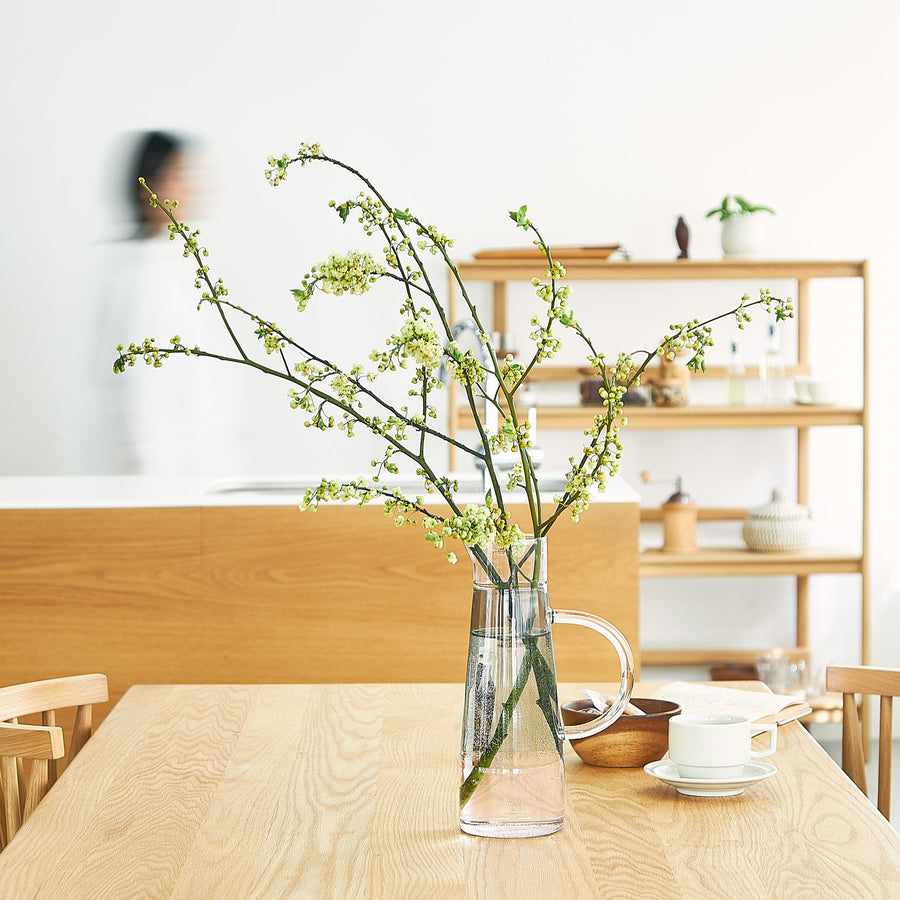
Spiraea thunbergii, with its long branches and many small flowers. If arranged in a tall vase, taking advantage of its long branches, it creates an impactful yet elegant impression ◎
The EDA VASE is designed to securely support tall branches while being slender and compact. Made of stable, lightweight, and durable polycarbonate, it's easy for beginners to maintain and change water.

Each flower of Spiraea thunbergii is a tiny bloom, less than 1 cm. If you cut the branches short and arrange them in a low vase, the impression of the lovely flowers becomes stronger.
Changing the atmosphere by adjusting the cutting length and the vase used is also one of the charms of branch plants ♪

EDA VASE | Compact vase to beautifully display branches
View Product 〉
Interior Examples with Spiraea thunbergii
Branches allow you to directly incorporate natural textures and beauty into your interior. The shape of the branches and the color of the flowers add a natural accent to the room.
Spiraea thunbergii is a lovely and beautiful branch plant with small, snow-like flowers blooming on weeping branches. Even displayed as is, its slender branches spread out beautifully.
It's also nice to place a vase on the living room floor or in the entryway to adorn your favorite, highly visible space.
Care when arranging in a vase
When arranging in a vase, the important thing is to regularly change the water and keep the vase clean. To make the flowers last longer, it's recommended to make small slits in the stem's cut end with pruning shears. This process helps the plant absorb water more easily.
Also, it's important to remove the lower flowers before arranging to prevent them from soaking in the water. If flowers are left in the water, it can lead to poor water quality in the vase and promote bacterial growth.
With a little effort, let's enjoy your Spiraea thunbergii as cut flowers for as long as possible!

Toyama Hamono | Pruning shears for a lifetime, capable of cutting thick branches
View Product 〉
Spiraea thunbergii Care Instructions
To enjoy branches for as long as possible, daily care is essential. Here, we'll explain the basic care methods for commonly available branches, including Spiraea thunbergii.
Basic Care
1. Recutting and Water Absorption on the Day of Receipt

Upon receiving the branches, recut them before placing them in a vase.
Additionally, make a cross-shaped cut at the base and use a knife to peel off the surface bark of the stem. It's recommended to peel only the part that will be submerged in water. This makes it easier for the plant to absorb water, extending the freshness of the branches.
Furthermore, using a freshness preservative can help maintain the freshness of the branches even longer.
■Original Freshness Preservative

SiKiTO has developed an original freshness preservative by researching the ideal nutrient balance for branches. This preservative is expected to provide essential nutrients to flowers and branches and keep the vase water clean.
The dedicated freshness preservative for branches is available here.
■Florist Knife for Improved Water Absorption

A florist knife, used for cutting flower stems, is also useful for peeling the bark of branches. The VICTORINOX florist knife, which helps improve water absorption by peeling the bark of the part submerged in water, is available here.
2. Strategic Placement of Branches
Spiraea thunbergii prefers well-ventilated, sunny, and moderately humid locations. Placing them in a bright spot, such as near a window, will help them thrive.
However, direct exposure to air conditioning can cause them to dry out and reduce flowering, so be careful.

3. Frequent Water Changes

Water quickly becomes cloudy if left unattended. It's recommended to change the water regularly before this happens.
If there are any slimy parts on the stem, gently rub them off by hand.
What to do if your branches start to lose vitality...
Cut the branches short and enjoy them in smaller arrangements.

Although branches are relatively sturdy and long-lasting, it's inevitable that they will gradually absorb less water as days pass.
If they start to look a little less vibrant, why not try cutting the branches shorter and arranging them differently?
By arranging them in smaller vases, you can create a different impression ◎
Try to find ways to enjoy your branches for even longer.
Spiraea thunbergii Trivia

Difference between Spiraea thunbergii and Spiraea cantoniensis
A flower often compared to Spiraea thunbergii is Spiraea cantoniensis (Kodomari). Both are popular spring branch plants that appear around the same early spring season. Both are deciduous shrubs belonging to the rose family, Spiraea genus, and their magnificent flower forms, bearing small white flowers, look similar.
To distinguish between the two plants, their names effectively describe their characteristics.
Spiraea cantoniensis has small white flowers clustered together to form a round ball, like a small temari ball, while Spiraea thunbergii has numerous small, snow-like flowers blooming profusely on its arching, willow-like branches.
Incidentally, Odemari (Viburnum plicatum), which looks very similar, belongs to the Adoxaceae family, not the rose family.
Both are representative branch plants that beautifully adorn the spring season.
Spiraea thunbergii's scientific name was given by Siebold
Delving into the origins of plant scientific names can reveal interesting histories and anecdotes.
The scientific name for Spiraea thunbergii is Spiraea thunbergii. This name was supposedly given by Siebold, a German physician and naturalist who came to Japan in the late Edo period and introduced Western learning to the country.
"Spiraea" is Greek for "spiral," named because the leaves of Spiraea thunbergii grow in a spiral pattern.
"thunbergii" is named after Carl Peter Thunberg, a Swedish physician and botanist who worked at the Dutch trading post in Dejima, Nagasaki, during the mid-Edo period (1775-76).
Siebold, a historically famous figure in Japan, came to Japan by government order in the late Edo period (1823-28) and stayed at the Dutch trading post. It is said that he named the plant in honor of his senior, Carl Peter Thunberg, who had arrived in Japan earlier.
One of Siebold's objectives in coming to Japan was to cultivate scholars of Dutch studies and research Japan's flora and fauna. During his six-year stay, he collected many plants and compiled books on Japanese flora and fauna after returning home. In his work "Flora Japonica," he mentions Spiraea thunbergii, showing a strong interest in it.
Tracing back from the scientific name of Spiraea thunbergii to Siebold's life and the history of the Netherlands and Japan at the time, one can truly appreciate that this delicate and ephemeral white flower has inhabited and been cherished in Japan since ancient times.
"Root Steaming" of Spiraea thunbergii
Fukushima Prefecture is a thriving area for the cultivation of Spiraea thunbergii as a branch plant. In Sukagawa City, a leading production area nationwide, unlike other regions, Spiraea thunbergii to be shipped are dug up entirely and "root-steamed" in greenhouses for about two weeks.
This "root steaming" allows the blooming period to be adjusted to meet demand, and since the plants remain attached to their roots until just before shipping, the flowers last longer after blooming.
However, because the plants are dug up entirely, it is very labor-intensive, and in recent years, shipping volumes have been decreasing.
Spiraea thunbergii can be enjoyed all year round
As a branch plant, Spiraea thunbergii is widely available from January to March. Its hard stems absorb water well, so frequent recutting and water changes are necessary.
Spiraea thunbergii is famous as a spring flower with many lovely white blossoms, but its refreshing foliage is also popular. It is available as a fresh green leafy plant in summer and as an autumn foliage plant in autumn.
Being able to enjoy its changes throughout the year, feeling the passage of seasons, is one of the charms of Spiraea thunbergii ◎
Summary of Spiraea thunbergii

Spiraea thunbergii is a deciduous shrub of the Rosaceae family, genus Spiraea, that blooms in spring.
Its flower meanings are "charm," "whimsy," "admirable," and "quiet thoughts." These were attributed to its charming flower appearance and the way its branches grow freely.
When its weeping branches are covered with many small white flowers, especially when growing in clusters, it creates a beautiful scene reminiscent of a snowscape.
Spiraea thunbergii continues to captivate people throughout the year: with its pure white, lovely flowers in spring, its lush green foliage in summer, and its beautiful autumn colors in fall.

【SiKiTOのよみもの】枝もの図鑑
よみもの一覧をみる〉

枝もの定期便|自宅で待つだけ、飾るだけ。
商品をみる 〉
PRODUCTS






![[Made to order] Green Summer Wreath made with summer branches (fresh flowers)](http://sikito.com/cdn/shop/files/20250702_-15.jpg?v=1751530871&width=900)


![[Made to Order] Four Seasons and Bonsai: Summer | Japanese Maple](http://sikito.com/cdn/shop/files/yomimono20250912.jpg?v=1756106914&width=900)
![[Pre-Order] Seasons and Bonsai: Summer | Gardenia](http://sikito.com/cdn/shop/files/DSC09951a.jpg?v=1779693971&width=900)
![[Made to Order] Seasons and Bonsai: Summer | Crape Myrtle](http://sikito.com/cdn/shop/files/DSC0468_2.jpg?v=1779774773&width=900)
We also recommend this article


A book introducing the appeal of "bra...


%0A%0A%0A%0A%0A%0A%0A%0A%0A%0A%0A%0A%0A%0A%0A%0APlant%20Name%0A%0ASpiraea%20thunbergii%20(Yuki-Yanagi)%0A%0A%0A%0A%0A%0A%0AScientific%20Name%0A%0ASpiraea%20thunbergii%0A%0A%0A%0A%0A%0A%0AEnglish%20Name%0A%0AThunberg's%20mead...)