

Keiozakura Cherry Blossoms: Features and Display Methods | Early-blooming cherry blossoms with small, delicate, pale pink flowers

Basic Information on Keio-zakura (Cherry Blossom)
| Plant Name | Keio-zakura |
| Scientific Name | Cerasus ‘Keiō-zakura’ |
| English Name | Cherry Blossom |
| Other Names | Keio-zakura, Tokai-zakura, Gakunan-zakura, Keitaro-zakura |
| Family/Genus | Rosaceae/Prunus |
| Classification | Deciduous broadleaf/Tall tree |
| Origin | Japan |
| Distribution Period | December to April |
| Distribution Volume | ★★★★★ |
| Longevity | ★★★★☆ |
*★ indicates a 5-level rating.
When placed in a warm room, the buds bloom within a few days, but after the flowers fall, young leaves appear. The changing appearance from flowers to green leaves can be enjoyed for a long time, so the longevity rating is 4.
Characteristics of Keio-zakura
Keio-zakura is a deciduous tall tree of the genus Prunus in the rose family. Unlike Somei-Yoshino, which represents Japan, Keio-zakura does not have a thick trunk. Instead, it is characterized by thin branches clustered together, with small, pale pink flowers blooming at their tips.
It is a variety created by cross-breeding Prunus pseudocerasus (Chinese cherry) as a rootstock with Prunus subhirtella (Kohi-gan-zakura), and is a type of Prunus campanulata (Kanhi-zakura).
It is known as an "early-blooming cherry" that flowers earlier than general cherry trees, around mid-March, allowing one to feel the arrival of spring ahead of time. It is often displayed on special occasions such as New Year's, graduation ceremonies, and entrance ceremonies, and is a branch that suits festive scenes well.

Flower Language of Keio-zakura
The flower language of Keio-zakura includes "purity" and "spiritual beauty." Flower meanings are sometimes derived from interesting anecdotes or express the appearance of the flower itself.
"Purity"
"Purity" refers to a state of being unsullied and clean. This meaning was attributed because the pure pink and white flowers bloom in a clean and beautiful manner.
"Spiritual Beauty"
This flower meaning originates from the Western flower meaning "spiritual beauty."
There is an anecdote that when George Washington, the first president of the United States, was a child, he accidentally cut down a cherry tree that his father cherished. When he honestly confessed, he was praised for his honesty.
It is said that in conjunction with this episode, and to represent not only outward beauty but also spirituality and dignity, "spiritual beauty" was given as a special flower meaning.
How to Display Keio-zakura

Keio-zakura is a flower characterized by thin branches that further branch into smaller ones, with delicate pink flowers blooming at their tips.
Because it branches out like a spray, it is easy to handle and is a popular variety used in ikebana and flower arrangements, although it differs from the cherry blossoms you see during hanami.
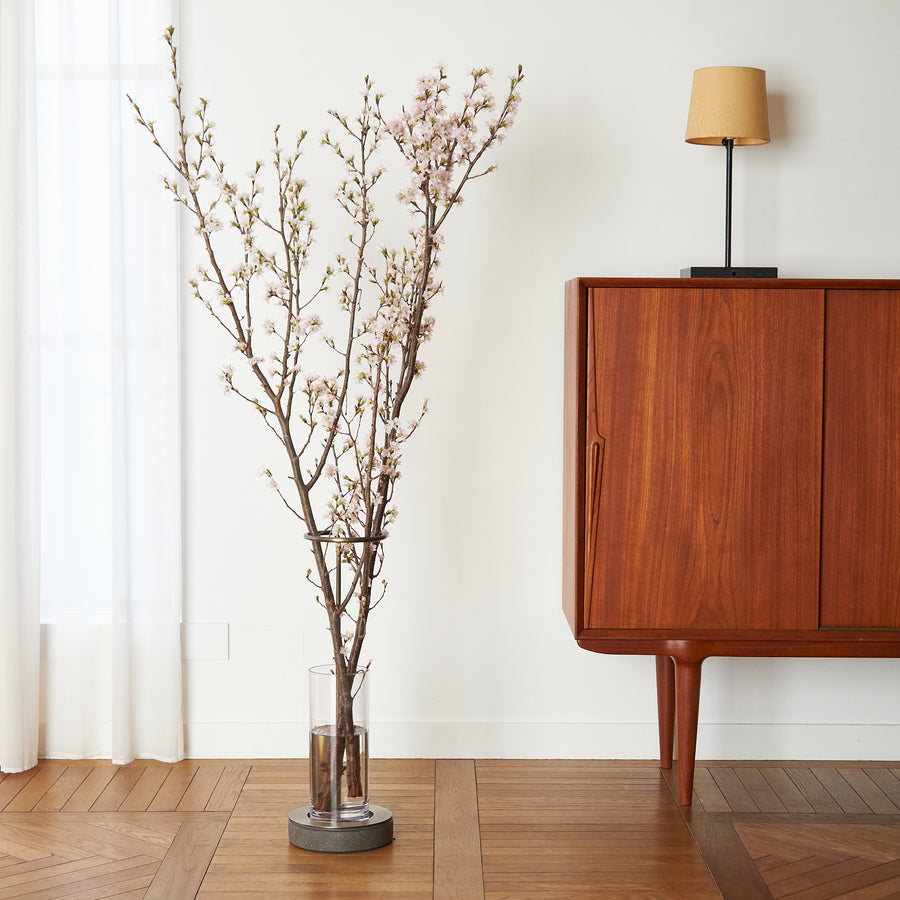
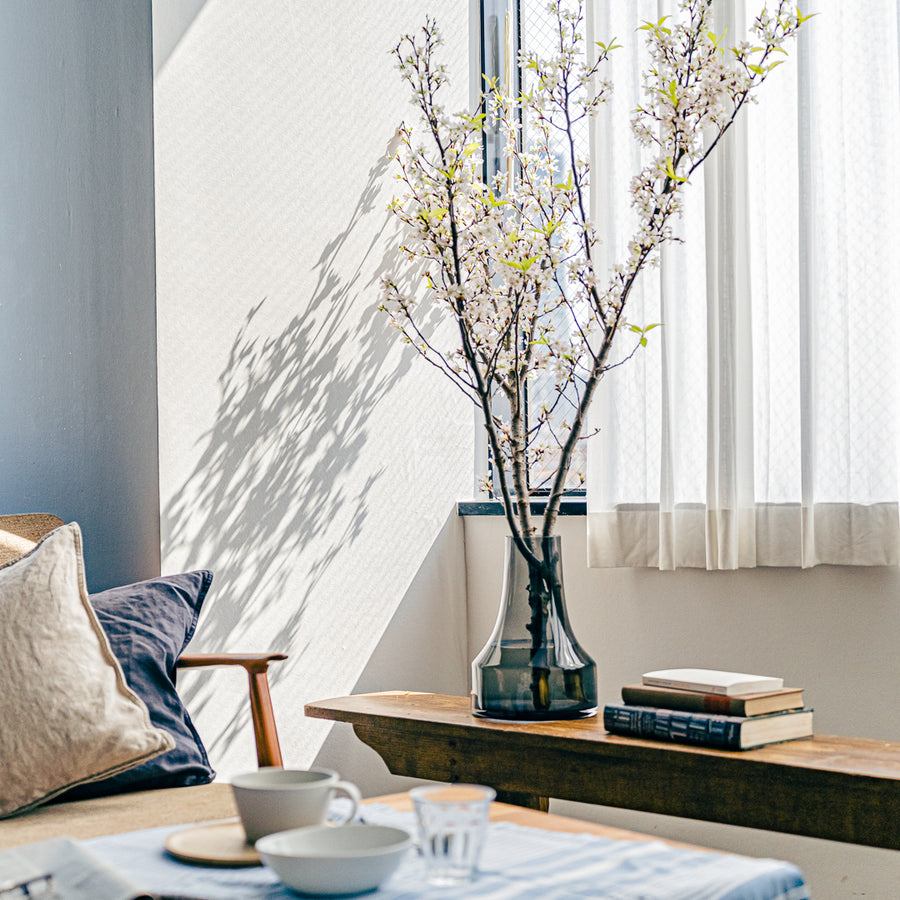
When arranging cherry blossoms at home, it is recommended to arrange them so that the vase and the cherry branch are in a ratio of about 1:2, to best highlight their volume and beauty.
Try arranging the branches so they naturally lean towards the vase.

EDA VASE | A compact vase for beautifully displaying branches
View Product 〉
Examples of Keio-zakura in interior decor
Keio-zakura blends well with Japanese-style interiors. It suits clear vases and also simple ceramic vases. Why not create an elegant atmosphere by pairing it with interior decor in subdued colors?
Placing the vase on the living room floor or in the entryway can also brighten up your favorite, frequently seen spaces.
Precautions when arranging in a vase
When arranging in a vase, the main point to be careful about is to cut the branches to fit the vase if they are too long. If displayed too long, the balance may be off, or the branches may spread too much and be difficult to manage.
Making a cut in the cross-section of the branch that will be in water will increase the surface area exposed to water, improving water absorption. The amount of water in the vase should be about one-third of the branch's length, and it should be changed frequently.
When cutting branches, it is recommended to use pruning shears for branches or woody plants. The trick to choosing pruning shears is to select a size that fits your hand.

Toyama Hamono | Pruning shears that can cut thick branches and will last a lifetime
View Product 〉
How to Care for Keio-zakura
Keio-zakura can be enjoyed for about a month as a cut branch if cared for properly, understanding its characteristics. Although it lasts relatively long, daily care is essential. Here, we introduce basic care methods for cut branches.
Basic Care
1. Recutting on the day of receipt

Recut the branches and arrange them in a vase on the day they arrive.
At that time, make a cross-cut at the base and peel off the bark to help them absorb water more easily.
To enjoy cut branches for even longer, it is recommended to arrange them in water containing a floral preservative. Preservatives have the effect of preventing the vase water from getting dirty and keeping the flowers vibrant.
■Freshness Preserver for longer enjoyment of branches

Why not try a freshness preserver to provide necessary nutrients to branches and keep the vase water clean? It has the effect of dissolving sap at the cut end to improve water absorption, allowing you to enjoy branches for longer.
Branch-specific freshness preserver is available here.
■Florist's knife to improve water absorption

The VICTORINOX florist's knife, which improves water absorption by peeling the bark from the part that will be submerged in water, is available here.
It offers reliable quality loved by professionals worldwide.
2. Choose a comfortable spot for the branches
Branches are best placed in a cool, well-ventilated area away from direct air conditioning drafts.
They have a presence that changes the impression of any space, whether in the living room, entryway, or kitchen. Avoid direct sunlight and choose a comfortable spot for your branches.
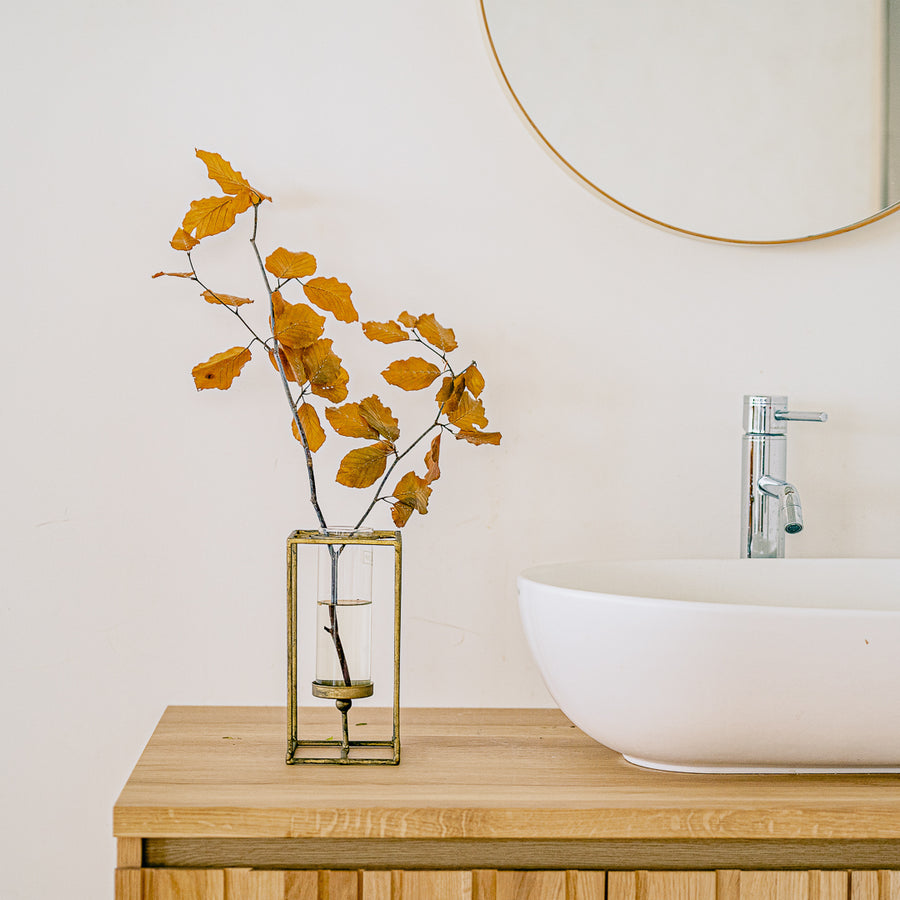
It's also good to display them in the bedroom or bathroom.
3. Frequent water changes

Change the water frequently before it becomes cloudy. When doing so, recutting the stems will help them absorb water again.
If there are any slimy parts, gently rub them off with your hand.
What to do if the branches are still not doing well...
Cut short and display

Even with daily care, over time, branches inevitably become less able to absorb water. In such cases, one option is to boldly cut them into shorter pieces.
Shorter pieces will absorb water more easily, and you can enjoy them in a different way by arranging them in small vases.
Trivia about Keio-zakura

Various Japanese Cherry Blossoms
Sakura (cherry blossoms) are deciduous tall trees or shrubs of the genus Prunus in the rose family. They are widely distributed mainly in temperate regions of the Northern Hemisphere, but species that produce beautiful flowers are concentrated in Asia, particularly in the Japanese archipelago.
In Japan, there are over 100 species of wild cherry blossoms, including variations, based on nine main types such as Yama-zakura and Oshima-zakura. Kanhi-zakura, which is believed to have become naturalized, also exists in Okinawa.
Furthermore, there are over 200 cultivated varieties developed from these. Their flower colors, sizes, and branching habits vary slightly, each with its own characteristics.
Among them, Keio-zakura is a type of Kanhi-zakura, characterized by its relatively early blooming and large notches at the tips of its petals.
Origin of the name Keio-zakura
Keio-zakura is a type of cherry blossom created by grafting and cross-breeding Prunus pseudocerasus (Chinese cherry) and Prunus subhirtella (Higan-zakura). It was developed in 1930 by Keitaro Yoshinaga, who lived in Kurume City.
The name "Keio-zakura" was derived by taking the character "Kei" from "Keitaro." "O" (翁) is an honorific used to refer to an elderly man or an old person. So the name has a nuance like "Grandpa Kei's cherry blossom."
Incidentally, Keio-zakura also has the alternate name "Keitaro-zakura."
Yamagata Prefecture is Japan's top producer
Keio-zakura blooms earlier than common cherry blossoms, but in a natural environment, it flowers around mid-March. However, due to the high demand for Keio-zakura for ornamental purposes, those grown through forcing cultivation are shipped from mid-December to March.
In Yamagata Prefecture, forcing cultivation was introduced early, and they adopted a unique production method called the "bush-type cultivation method", successfully mass-producing it. Since then, they have shipped it nationwide, boasting the highest shipping volume in Japan. It is said to have significant advantages for farmers as it can be shipped during the off-season.
Keio-zakura, often displayed for New Year's, graduation ceremonies, and entrance ceremonies as a flower that brings an early sense of spring, owes its early shipping period to the efforts of farmers in Yamagata Prefecture and other regions.
Summary of Keio-zakura

Keio-zakura is known as an "early-blooming cherry" that flowers earlier than common cherry blossoms, around mid-March. It is characterized by thin branches clustered together, with small, pale pink flowers blooming at their tips.
Its flower language includes "purity" and "spiritual beauty."
Since it appears in the market from the cold season, Keio-zakura is also displayed for New Year's and suits festive occasions such as graduation and entrance ceremonies. Its delicate small flowers, blooming diligently in clusters, bring an early sense of spring.

【SiKiTOのよみもの】枝もの図鑑
よみもの一覧をみる〉

枝もの定期便|自宅で待つだけ、飾るだけ。
商品をみる 〉
PRODUCTS
![[Made to order] Green Summer Wreath made with summer branches (fresh flowers)](http://sikito.com/cdn/shop/files/20250702_-15.jpg?v=1751530871&width=900)
![[Made to Order] Four Seasons and Bonsai: Summer | Japanese Maple](http://sikito.com/cdn/shop/files/yomimono20250912.jpg?v=1756106914&width=900)
![[Pre-Order] Seasons and Bonsai: Summer | Gardenia](http://sikito.com/cdn/shop/files/DSC09951a.jpg?v=1779693971&width=900)
![[Made to Order] Seasons and Bonsai: Summer | Crape Myrtle](http://sikito.com/cdn/shop/files/DSC0468_2.jpg?v=1779774773&width=900)
We also recommend this article

[Branching Books Publication] With a gift! Announcement of the "Branching Books Pre-order Campaign"
On March 27, 2024, Kawade Shobo Shins...

What is Japandi? | Features of a Familiar Interior and Stylish Ways to Incorporate It
Japandi is the latest interior d...


%0A%0A%0A%0A%0A%0A%0A%0A%0A%0A%0A%0A%0A%0A%0A%0APlant%20Name%0A%0AKeio-zakura%0A%0A%0A%0A%0A%0A%0AScientific%20Name%0A%0ACerasus%20%E2%80%98Kei%C5%8D-zakura%E2%80%99%0A%0A%0A%0A%0A%0A%0AEnglish%20Name%0A%0ACherry%20Blossom%0A%0A%0A%0A%0A%0A%0AOther%20Names%0A%0AKeio-z...)