

Spiraea (Kodemari) Characteristics and Display Tips | A branch with small white flowers like a temari ball

Basic Information About Kodemari (Reeves Spirea)
| Plant Name | Kodemari (Reeves Spirea) |
| Scientific Name | Spiraea cantoniensis |
| English Name | Reeves spirea |
| Other Names | Suzukake, Temaribana, Chinese name: Maye Xiuqiu |
| Family/Genus | Rosaceae / Spiraea genus |
| Classification | Deciduous / Shrub |
| Origin | China |
| Availability Season | January - March |
| Availability Volume | ★★★★★ |
| Longevity | ★★☆☆☆ |
*Stars indicate a 5-point scale.
Characteristics of Kodemari
Kodemari is a deciduous shrub belonging to the genus Spiraea in the rose family. As its name suggests, Kodemari is a beautiful branch adorned with tightly packed clusters of small flowers resembling miniature temari balls, gracefully drooping from pliable branches.
It was introduced from China and has been cultivated as an ornamental plant since the Edo period.
Its charming flowers and delicate branches have made it a popular spring flowering tree, used in home gardens and as cut flowers.
Furthermore, its delicate, small flowers, reminiscent of baby's breath when viewed from a distance, and its gracefully arching branches are captivating, making it a popular floral material that can serve as both a focal point and an accent in flower arrangements.
You can often spot Kodemari with its small white flowers blooming in parks and garden beds during spring.

Kodemari Flower Meanings
Kodemari has the flower meanings of "friendship," "effort," "grace," "elegance," and "cowardice."
"Friendship"
This represents the sight of small white flowers, about 3mm in size, blooming close together, unfazed by rain and wind. Their appearance evokes the bond of friendship, as if holding hands and helping each other.
"Effort"
It is said that this meaning comes from the delicate kodemari being supported by its slender branches, and from the small flowers gathering together in an effort to make the kodemari flower appear larger.
"Grace" and "Elegance"
These meanings are said to be derived from the elegance of Kodemari's small white flowers and their refined, pure appearance. Their look evokes an elegance reminiscent of a bride enveloped in a white veil.
"Cowardice"
Kodemari is characterized by its small flowers gathering to form round, ball-like clusters. The detailed origin of this flower meaning is unknown, but it is said to be associated with "cowardice" because the flowers cannot bloom individually but rather must gather together.
With flower meanings like "friendship" and "effort," it's recommended to give them with a message to a friend preparing for a presentation, sports event, or important exam ◎.
"Grace" and "elegance" represent refinement and beauty, making them perfect gifts for newlyweds or a beloved partner.
However, Kodemari also has a negative flower meaning, "cowardice," so it's a good idea to include warm words when giving it as a gift.
How to Display Kodemari

Although each flower is small, Kodemari's small blooms gather to form rounded, ball-like shapes. The sight of numerous such "temari" balls blooming profusely and the branches gracefully arching is captivating.
When displaying them, arrange them in a vase so that they flow from side to side, considering the direction of the flowers. Since the branches have a front and back, adjust the balance by utilizing their natural orientation.
Kodemari, with its many flowers, can be surprisingly heavy. If you're arranging a large branch, it's recommended to choose a vase with good stability and weight.
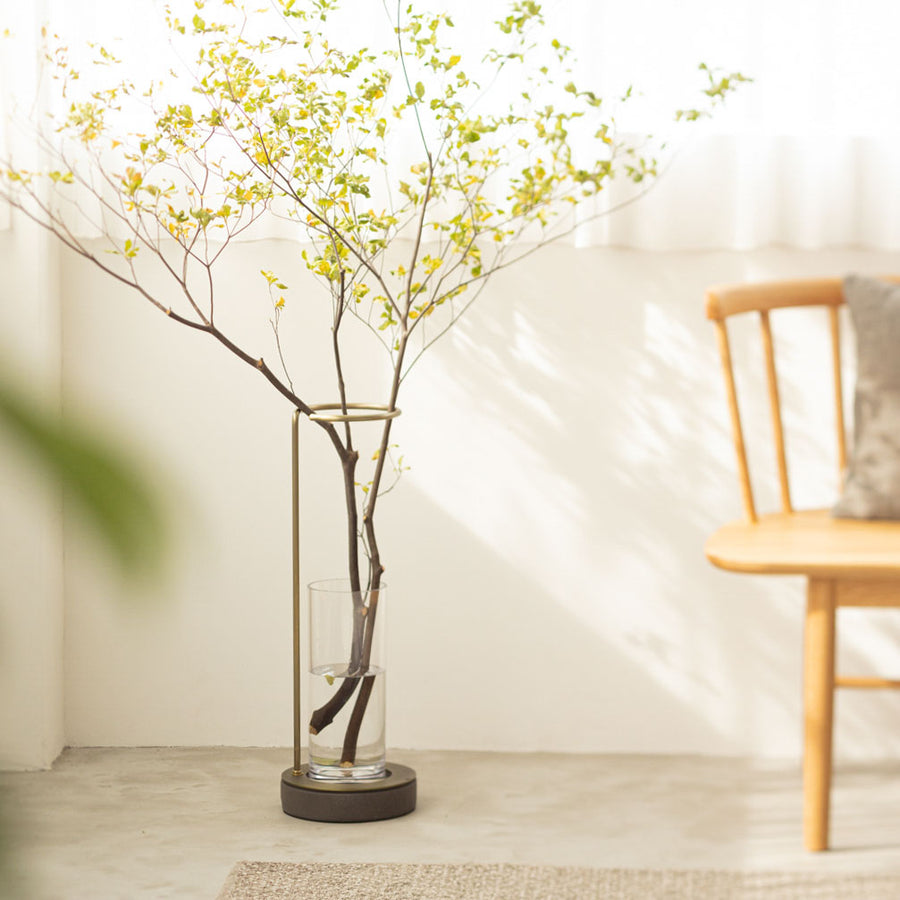
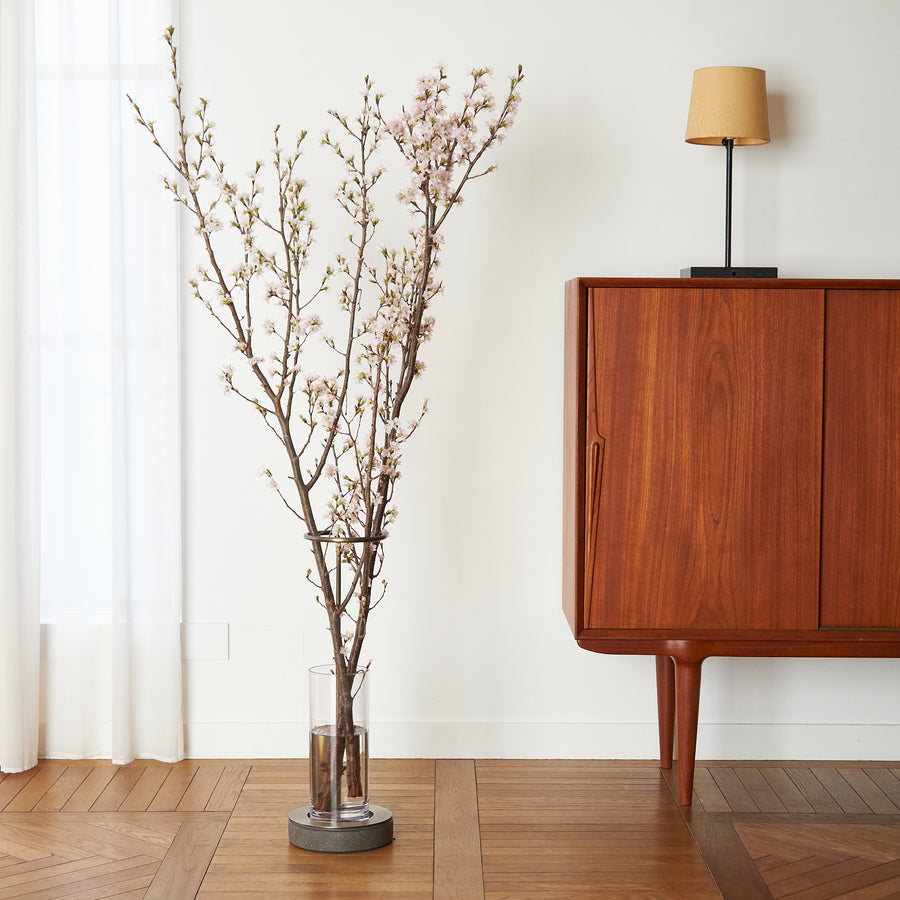
The EDA VASE is designed to be slim and compact, yet capable of securely supporting tall branches. The concrete base weighs approximately 4kg, providing excellent stability, making it easy for even beginners to care for and change water. We highly recommend it!◎

▶EDA VASE | A compact vase for beautifully displaying branches
View product 〉
Kodemari Interior Decor Examples
One of the charms of branches is their ability to dramatically change the atmosphere of a room, even with the same interior.
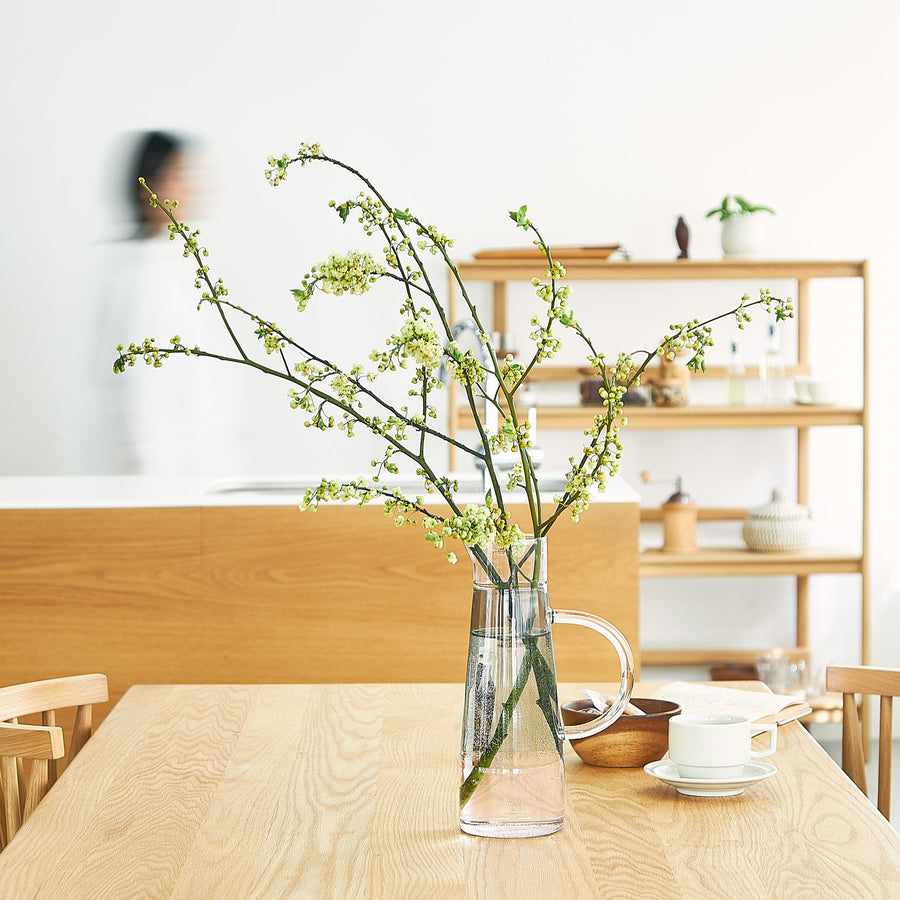
Kodemari is a branch that allows you to enjoy the harmony of pure white small flowers and green leaves. You can display it lavishly on a dining table, or place a large vase on the living room floor and arrange it. It naturally blends into any interior, whether Japanese or Western, and asserts its presence.
It's also recommended to cut and display them according to the various sizes and designs of vases you have at home.
Care when arranging in a vase
When decorating with flowers in a vase, it is important to change the water frequently and keep the vase clean. At that time, by cutting the stem in "kirimodoshi" (recutting), the cut end becomes fresh and absorbs water better.
Kodemari is a branch that tends to lose water easily, so it's recommended to recut it regularly. If there are too many leaves, it will lose water even faster, so it's a good idea to thin them out to some extent.
Also, it's important to remove the lower flowers before arranging them so that the flowers on the branches don't soak in the water. If the flowers remain submerged in water, it can lead to water quality deterioration and bacterial growth in the vase.

Toyama Hamono | Heavy-duty pruning shears that will last a lifetime, even for thick branches
View product 〉
Kodemari Care Instructions
As mentioned, Kodemari branches tend to absorb water easily. To enjoy them for as long as possible, daily care is essential. Here, we'll explain the basic care methods for branches.
Basic Care
1. Recutting and watering on the day of receipt

On the day you receive the branches, recut them before arranging them in a vase. Recutting is a method of pruning overgrown stems or branches to rejuvenate the plant.
Additionally, make a cross-shaped cut at the base and use a knife to peel off the surface skin of the stem. The key is to only peel the part that will be submerged in water for absorption.
Also, as a technique to maintain water quality, arranging them in water with a floral preservative is one method.
■Original freshness preservative for maintaining water quality

SiKiTO's original freshness preservative is formulated with an optimal balance of ingredients for branches. It provides essential nutrients to the flower branches and is expected to keep the vase water clean. It also contains sap-dissolving ingredients, which are effective against the common problem of reduced water absorption in branches due to sap.◎
The freshness preservative specifically for branches can be found here.
■Florist knife for better water absorption

A florist knife for cutting flower stems is also useful for peeling the bark off branches. The VICTORINOX florist knife, which helps improve water absorption by peeling the bark from the part that will be submerged in water, can be found here.
2. Display branches in a suitable location
Kodemari prefers a sunny and well-ventilated environment. Displaying it in a south-facing or east-facing location will help it grow vigorously. In summer, to avoid strong sunlight, a moderately shaded spot is ideal.◎
Be careful that direct exposure to air conditioning can cause drying and poor flowering.

3. Change the water frequently

It is recommended to change the water frequently before it becomes cloudy. Recutting the stems at this time will also help them absorb water better.
If there is any sliminess, gently rub it off with your hand.
When your branches are not looking well...
Cut the branches short and enjoy them in smaller arrangements.

As days pass, it gradually becomes harder for them to absorb water. In such cases, it might be a good idea to boldly cut them short and arrange them in smaller pieces.
Also, it's a good idea to pluck any flowers that are about to finish blooming. Even after the flowers have fallen, you can still enjoy them as green branches.
The rounded, jagged leaves have a different charm than when they are in bloom.
Be creative and enjoy your branches for longer.
Kodemari Trivia

Kodemari has various names
Kodemari is a plant that came from China. It is believed to have become established in Japan and cultivated around the Edo period.
Initially, it was called "Suzukake," but around the early Edo period, the name "Kodemari" (small hand ball) became widespread due to the appearance of its small white flowers blooming in round clusters, resembling temari balls.
The old name "Suzukake" is said to derive from the way the flowers bloom individually on arching branches, looking like bells hung on a branch.
It also had other names, such as "Dangobana" (dumpling flower) after rice dumplings and "Temaribana" (hand ball flower) after hand balls, often compared to familiar objects.
These endearing and lovely names clearly show how Kodemari has been loved by people for a long time.
How to Grow Kodemari
Under natural conditions, flowering occurs from April to May, but those grown in greenhouses for forced cultivation start to appear around January, and gradually, naturally blooming ones from outdoor cultivation, known as season-blooming, also become available.
By the way, if you mix food coloring or dye into the water in the vase, the flowers will take on a delicate hue, so it might be fun to experiment a little.
Because it tends to lose water easily, frequent recutting is necessary. While the harmony with its gently colored leaves is also appealing, if there are too many leaves, it will lose water more easily, so it's a good idea to thin them out to some extent.
Kodemari Summary

Kodemari is a deciduous shrub belonging to the genus Spiraea in the rose family, blooming in spring. As its name suggests, it is a beautiful branch adorned with numerous clusters of small flowers resembling miniature temari balls.
The flower meanings of Kodemari are "friendship," "effort," "grace," "elegance," and "cowardice." These meanings were given due to the way its small flowers bloom in clusters.
With its charming flowers and delicate branches, it is a quintessential spring flowering tree, popular for home gardens and as cut flowers.
Its floral appearance has a loveliness that makes you genuinely feel, "It's wonderful to welcome spring again this year."

【SiKiTOのよみもの】枝もの図鑑
よみもの一覧をみる〉

枝もの定期便|自宅で待つだけ、飾るだけ。
商品をみる 〉
PRODUCTS



![[Made to order] Green Summer Wreath made with summer branches (fresh flowers)](http://sikito.com/cdn/shop/files/20250702_-15.jpg?v=1751530871&width=900)

![[Made to Order] Four Seasons and Bonsai: Summer | Japanese Maple](http://sikito.com/cdn/shop/files/yomimono20250912.jpg?v=1756106914&width=900)
![[Pre-Order] Seasons and Bonsai: Summer | Gardenia](http://sikito.com/cdn/shop/files/DSC09951a.jpg?v=1779693971&width=900)
![[Made to Order] Seasons and Bonsai: Summer | Crape Myrtle](http://sikito.com/cdn/shop/files/DSC0468_2.jpg?v=1779774773&width=900)
We also recommend this article

Forsythia Characteristics and Display Tips | A Branch with Bell-Shaped Yellow Flowers
A deciduous broadleaf shrub of the ge...


%0A%0A%0A%0A%0A%0A%0A%20%20%0A%0A%0A%0A%0A%0A%0A%0A%0APlant%20Name%0A%0AKodemari%20(Reeves%20Spirea)%0A%0A%0A%0A%0A%0A%0AScientific%20Name%0A%0ASpiraea%20cantoniensis%0A%0A%0A%0A%0A%0A%0AEnglish%20Name%0A%0AReeves%20spirea%0A%0A%0A%0A%0A%0A%0AOther%20N...)