

Natsu-haze (Japanese Blueberry Tree): Characteristics and Display Tips | A Branch That Boasts Beautiful Autumn Foliage in Summer

Natsuhaze (Summer Wax-tree) Basic Information
| Plant Name | Natsuhaze (Summer Wax-tree) |
| Scientific Name | Vaccinium oldhamii |
| English Name | Japanese Blueberry |
| Other Name | Japanese Blueberry |
| Family/Genus | Ericaceae / Vaccinium |
| Classification | Deciduous shrub |
| Origin | Japan, China, Korean Peninsula |
| Market Season | May - August |
| Market Volume | ★★☆☆☆ |
| Longevity | ★★★☆☆ |
* ★ indicates a 5-point scale
Characteristics of Natsuhaze
Natsuhaze is a deciduous shrub belonging to the genus Vaccinium in the family Ericaceae. It grows widely in Japan and produces small, bell-shaped flowers from May to June. It is called Natsuhaze (Summer Wax-tree) because its beautiful autumn foliage in summer resembles that of the Japanese wax-tree.
One of Natsuhaze's characteristics is that you can enjoy its beautiful autumn foliage twice, in summer and autumn.
In autumn, small purplish-black berries ripen in clusters. The fruit is characterized by its sourness and astringency, and is also known as "Japanese blueberry" as it is used in jams and fruit liqueurs.
As a branch, it is mainly available from early summer to early autumn, showing various expressions from fresh green leaves to autumn foliage and berries. It is a plant that colors each season and makes us feel the passing of time.

Natsuhaze Flower Language
The flower language of Natsuhaze includes "unadorned beauty," "as is," and "delicious meal." These flower meanings are imbued with symbolism representing natural beauty and individuality.
"Unadorned Beauty"
Natsuhaze's white, urn-shaped flowers have a simple yet charming appearance, somewhat modest and elegant.
This flower meaning symbolizes its unpretentious beauty.
"As Is"
The Natsuhaze branches distributed in summer are very simple and dignified.
The phrase "as is" symbolizes the natural growth and beauty of these branches and leaves, and is said to suggest a way of life that does not pretend.
"Delicious Meal"
Natsuhaze, which bears blueberry-like fruits in autumn, is sometimes used for jams and fruit liqueurs, and its flower meaning evokes a warm family dining table and togetherness.
These flower meanings are perfect for appreciating the characteristics of Natsuhaze and the changing seasons◎
How to Display Natsuhaze

The key to displaying Natsuhaze is to make the most of its simple, natural branches and seasonal charm!
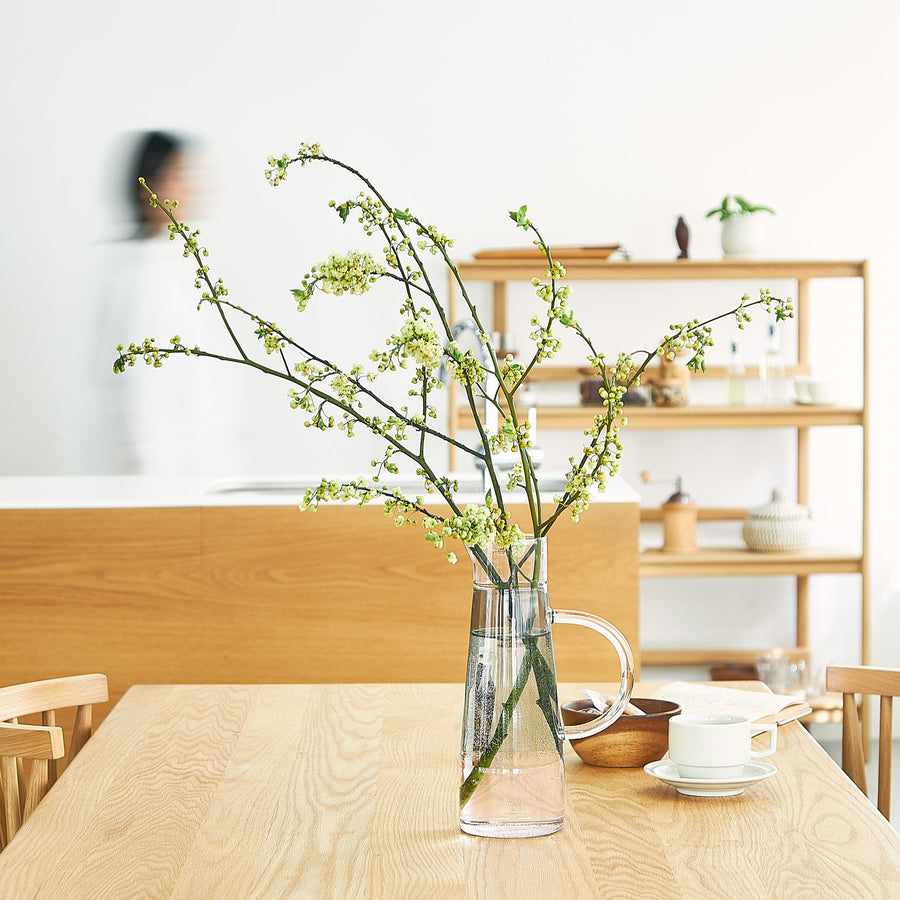
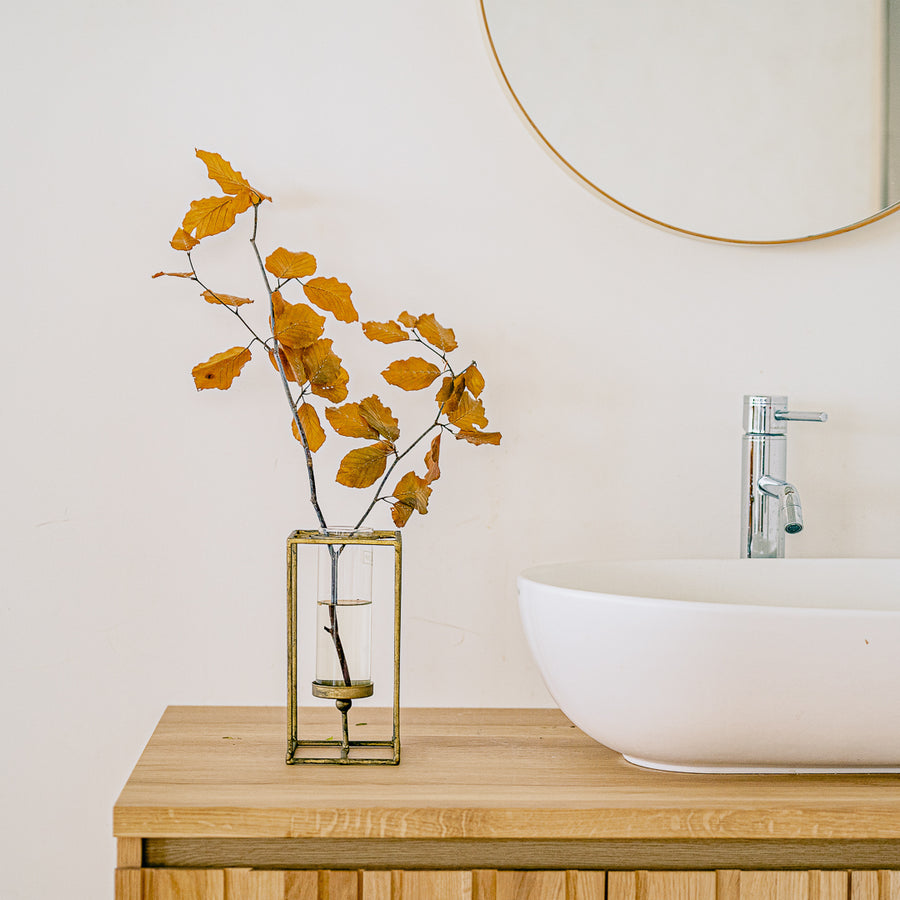
To enhance Natsuhaze's rustic ambiance, simple, tall vases are recommended. Ceramic or glass vases are particularly compatible, highlighting its natural colors. ◎
For the ratio of the vase to the Natsuhaze branch length, aim for about 1 to 1.5. The ideal arrangement is to avoid over-decorating and enjoy the empty space.
It's also lovely to combine it with other floral materials, keeping a natural arrangement in mind. For example, by utilizing the branch's shape to create height and adding lower flowers around it, you can create a three-dimensional design.
Please try displaying it with a feeling of enjoying its natural atmosphere!

Flora | A masterpiece vase from a brand appointed by the Danish Royal Court
View Product 〉
Precautions when arranging in a vase
When arranging in a vase, the first thing to be careful about is to cut the branches to fit the vase if they are too long. If left too long, the balance may be poor, or the branches may spread too much and be difficult to manage.
Natsuhaze branches absorb water well, but their water absorption gradually decreases over time, so with each water change, make a fresh cut and incise the stem in a cross shape with scissors.
When making cuts in branches, it is recommended to use pruning shears specifically for branches and woody plants. Choose pruning shears that fit your hand.

Toyama Hamono | Pruning shears that can cut thick branches, a lifelong tool
View Product 〉
Natsuhaze Care Tips
To enjoy Natsuhaze branches for longer, a little daily care is very important. Here are basic care tips for branches.
Basic Care
1. Trim upon receipt

It is recommended to trim the branches on the day of receipt and arrange them in a vase. Making a cross-shaped cut at the base and stripping the bark will promote water absorption.
Furthermore, using water with a flower preservative will keep the water clean and allow you to enjoy the vibrant color of the flowers for longer.
It's a small effort to appreciate the beauty of branches for a longer time◎
■Flower preservative for long-lasting branches

Why not try using a flower preservative to provide essential nutrients to branches and keep the vase water clean? It has the effect of dissolving sap at the cut ends to improve water absorption, allowing you to enjoy branches for longer.
Dedicated flower preservative for branches available here.
■Florist knife to improve water absorption

The VICTORINOX florist knife, which improves water absorption by stripping the bark from the submerged part of the stem, is available here.
It is a reliable quality product used by professionals worldwide.
2. Choose a comfortable spot for your branches
Branches have the power to transform the atmosphere of any space, whether it's the living room, entrance, or kitchen.
When placing them, an ideal spot is cool, well-ventilated, and not directly exposed to air conditioner drafts. It's also important to avoid direct sunlight. Choose an environment where the branches can remain comfortable in their natural state.
Enjoy the changing seasons and fully appreciate the charm of Natsuhaze◎
3. Frequent water changes

Change the water frequently before it becomes cloudy. At that time, recutting the stems will also help them absorb water more easily.
Removing any slime from the stems or cutting them diagonally are small efforts that help maintain their beautiful condition.
What to do if your branches are still not looking good...
Cut them shorter and enjoy them in smaller arrangements

Even with daily care, branches can eventually have difficulty absorbing water. In such cases, one option is to bravely cut them into shorter pieces.
Cutting them shorter improves water circulation, and arranging them in smaller vases allows you to enjoy the branches with a fresh new look.
Natsuhaze Trivia

Types and Cultivation of Natsuhaze
There are two types of Natsuhaze, one of which is called Gosukehaze. In Kansai, Natsuhaze often refers to Gosukehaze.
During its circulation period from May to August, you can enjoy its diverse expressions, from fresh green leaves to reddish autumn foliage, and the black berries that ripen in autumn.
Some are cultivated in fields, while others are harvested from mountains, and especially those harvested from mountains have a wild and impressive branching habit. You often see truly spectacular ones over 2 meters tall at markets.
Since it absorbs a lot of water, change the water frequently.
Nutrient-rich Natsuhaze fruit
The purplish-black fruit of Natsuhaze is more acidic and astringent than blueberries, with a wilder flavor. It is sweet and sour and is often processed into jams, fruit liqueurs, and sauces.
It can be eaten raw, but due to its strong acidity, it is used as an accent in sweets and dishes.
The fruit contains large amounts of anthocyanins and polyphenols, and is said to have very high antioxidant activity. It is expected to have health benefits such as improving immunity and preventing lifestyle-related diseases.
In addition, the purple pigment contained in the fruit is said to be darker than that of blueberries and is also used as a dye for cloth.
Natsuhaze Summary

Natsuhaze (Summer Wax-tree) is named because its beautiful autumn foliage in summer resembles that of the Japanese wax-tree. It is related to blueberries, and is sometimes called "Japanese blueberry" because it bears fruit in autumn.
Its flower language includes "unadorned beauty," "as is," and "delicious meal," which are words associated with its simple, wild atmosphere and unpretentious beauty.
Furthermore, one of Natsuhaze's characteristics is that you can enjoy its autumn foliage twice, in summer and autumn. Please try decorating your room with this simple branch, which is beautiful in its natural form and colors the seasons◎

【SiKiTOのよみもの】枝もの図鑑
よみもの一覧をみる〉

枝もの定期便|自宅で待つだけ、飾るだけ。
商品をみる 〉
PRODUCTS


![[Made to order] Green Summer Wreath made with summer branches (fresh flowers)](http://sikito.com/cdn/shop/files/20250702_-15.jpg?v=1751530871&width=900)


![[Made to Order] Four Seasons and Bonsai: Summer | Japanese Maple](http://sikito.com/cdn/shop/files/yomimono20250912.jpg?v=1756106914&width=900)
![[Pre-Order] Seasons and Bonsai: Summer | Gardenia](http://sikito.com/cdn/shop/files/DSC09951a.jpg?v=1779693971&width=900)
![[Made to Order] Seasons and Bonsai: Summer | Crape Myrtle](http://sikito.com/cdn/shop/files/DSC0468_2.jpg?v=1779774773&width=900)
We also recommend this article


%20Basic%20Information%0A%0A%0A%0A%0A%0A%0A%0A%0A%0A%0A%0A%0A%0A%0A%0APlant%20Name%0A%0ANatsuhaze%20(Summer%20Wax-tree)%0A%0A%0A%0A%0A%0A%0AScientific%20Name%0A%0AVaccinium%20oldhamii%0A%0A%0A%0A%0A%0A%0AEnglish%20Name%0A%0AJapanese%20Blueberry%0A%0A%0A%0A%0A%0A%0AOther%20...)